
By Antonietta Breitenfeldt, M. Ed. | BrightSpot Labs
Every fall, families sit down to figure out whether their student should apply early decision vs. early action, and a surprising number of them are not entirely sure what either term means. The college admissions calendar has gotten complicated, and the stakes around getting these decisions right feel overwhelming. Apply early decision to the wrong school and your student could be locked into an offer that does not work financially. Skip early action at a school that rewards it and you might be competing against a smaller, more motivated pool in the spring. This guide explains what each option means, when each might make sense, and what most families may not realize until it is too late to change course.
Early Decision vs. Early Action: The Core Difference
The simplest way to explain it: Early Decision is a commitment. Early Action is not.
Early Decision (ED) is a binding application. If your student applies ED and is admitted, they are expected to enroll at that school, withdraw any other applications already submitted, and stop the rest of their college search. The typical ED deadline falls around November 1 or November 15, with decisions arriving in mid-December. Most schools also offer Early Decision II (ED II), which has the same binding commitment but a later deadline, usually January 1 to January 15, with decisions in February.
Early Action (EA) is non-binding. Your student applies early, receives a decision early, typically by mid-December or January, but retains the freedom to compare offers, visit admitted students weekends, and make a final decision by the regular May 1 deadline. They are not obligated to enroll anywhere until they choose to.
There is also a variant called Restrictive Early Action (REA) or Single-Choice Early Action (SCEA), used by a small number of highly selective schools including Harvard, Yale, Stanford, and Princeton. REA is non-binding like regular EA, but it restricts where a student can apply early. Specifically, students applying SCEA may not simultaneously apply ED or EA to other private colleges, though they can still apply EA to public universities. This is an important detail that catches some families off guard.

When Early Decision Makes Sense
ED is not right for every family. It is right for specific situations.
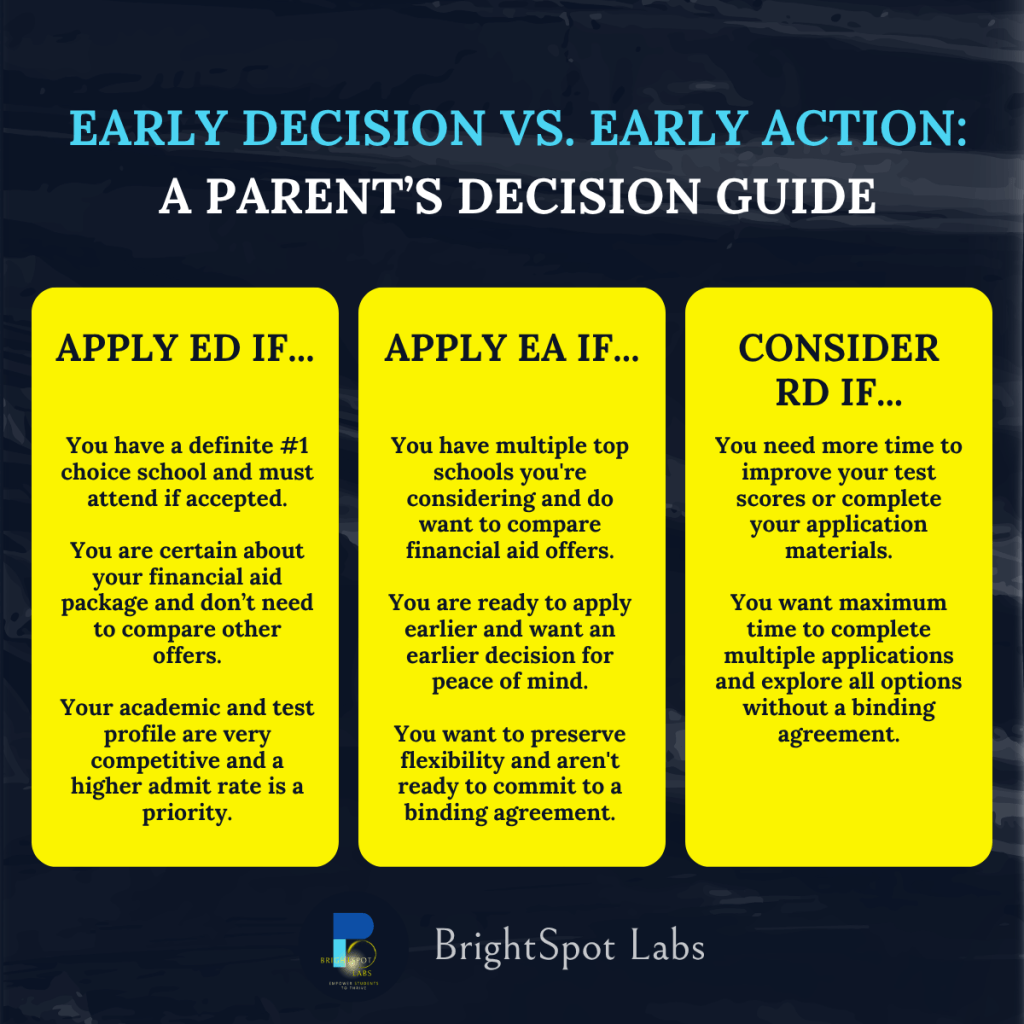
Your student should consider ED if they have a genuine, well-informed first choice. Not a school they think sounds impressive, not a school they have never visited, but a school they know deeply and are certain they want to attend above all others. They should have toured the campus, ideally spoken with current students, looked seriously at the academic programs in their intended area, and arrived at their preference through real research. Students who apply ED because they feel like they are supposed to are taking a binding commitment lightly.
The financial piece is the other critical factor. The National Association for College Admission Counseling (NACAC) has long documented that ED applicants give up the ability to compare financial aid offers, which can be a significant disadvantage for families who need aid to make the decision work. If your family is paying close attention to cost and needs to see multiple offers before committing, ED may not be the right move regardless of how strong the first-choice feeling is. The exception is if your family has already done the math, knows the school is affordable at full price or has a predictable aid formula you understand, and can commit to whatever offer arrives.
ED admission rates are often meaningfully higher than regular decision rates at many schools. Common App research consistently shows ED applicants are admitted at higher rates, though part of this reflects the fact that stronger, more committed applicants self-select into ED pools. The advantage is real but not guaranteed, and it should never be the primary reason for applying ED.
When Early Action Makes More Sense
EA is the better path for students who want the advantages of an early application without surrendering financial flexibility. If your student has a strong first choice but your family genuinely needs to compare financial aid offers before committing, EA (where available) threads that needle well.
EA is also worth pursuing at schools where it is available and your student is a competitive applicant. Getting an admission decision in December removes uncertainty, gives the student something to celebrate, and creates a safety net of known options before the spring RD decisions roll in. For a student who is prone to anxiety about the admissions process, having a strong EA acceptance in hand by January can meaningfully reduce the stress of the spring wait.
Many state flagship universities offer non-binding EA, and these are often underutilized by students who are focused exclusively on private college options. Applying EA to a strong public university while also applying EA or ED elsewhere can be an excellent strategic approach.
The Financial Aid Problem with Early Decision
This deserves its own section because it is where families most often get into trouble.
When a student is admitted ED, the school presents a financial aid offer. Because ED is binding, the family has very little leverage to negotiate that offer against a competing package. At schools that meet 100 percent of demonstrated need (a fairly short list of highly selective institutions), this matters less. But at schools that do not guarantee to meet full need, the ED offer might fall short of what the family expected, and the student is still technically committed to attend.
Most ED contracts do include language that allows a student to withdraw if the financial aid offer makes attendance genuinely impossible. But “genuinely impossible” is a high bar, and navigating that conversation after admission is uncomfortable and sometimes contentious. The cleaner approach is to use net price calculators at any ED school before applying, understand what the offer is likely to look like, and make sure the family is prepared to accept a realistic range of outcomes before submitting the application.
Families who are strong candidates for merit aid should be particularly careful with ED. Merit awards are sometimes less generous at highly selective schools, and applying ED eliminates the ability to use competing merit offers as negotiating leverage.
Real Questions Families Ask
“My daughter has a clear first choice and her stats are strong. Should she just apply ED?”
Possibly, but run the financial scenarios first. Use the school’s net price calculator with your actual income and asset information and look at what aid typically looks like for families in your situation. If the number is workable and she is genuinely committed beyond any doubt, ED is reasonable. If there is meaningful financial uncertainty or if her enthusiasm for the school is partly driven by prestige rather than a deep, specific connection, applying EA or RD and seeing multiple offers may be the smarter call.
“My son applied ED and got deferred. What happens now?”
A deferral from ED moves the application into the regular decision pool for consideration in the spring. He is no longer bound by the ED commitment. At this point, he should submit a strong letter of continued interest to the admissions office reaffirming his commitment to the school and sharing any meaningful updates since his application, improved grades, new achievements, or additional context that strengthens his case. He should also continue completing and submitting his other applications without delay, since RD deadlines are typically January 1.
“Can my child apply ED to one school and EA to another at the same time?”
In most cases, yes. Applying ED to one school while simultaneously applying EA to other schools is generally permitted, with one important exception: if the EA school uses Restrictive Early Action or Single-Choice EA (like Harvard, Stanford, Yale, or Princeton), applying ED elsewhere may violate their SCEA agreement. Read each school’s early application policies carefully before submitting anything. Violating these agreements can result in rescinded admission, which is a situation no family wants to navigate.
What You Might Be Missing
Families who focus only on the ED vs. EA choice often overlook a few things that matter just as much.
ED II is underused and worth considering. If a student’s first-choice school offers ED II and the November ED round feels too rushed, applying ED II in January gives extra time to strengthen the application, improve a test score, or confirm the financial picture while still signaling a binding commitment. Many schools admit a meaningful portion of their class through ED II.
Applying early does not guarantee a stronger application. Some students rush to meet the November 1 deadline before their application is truly ready. A polished RD application submitted in January will outperform a hurried ED or EA application in most cases. The early option only helps if the application itself is strong.
Some schools do not offer EA or ED at all. MIT, for example, offers EA but not ED. Many schools offer only RD. Before building a list around an early application strategy, confirm which schools offer which options and whether the early pool is actually more competitive or less so at each institution.
The May 1 deadline is later than most families realize. Even with regular decision, students have until May 1 to commit. That means a student with EA acceptances in hand in December can take four months to compare programs, visit, consider financial aid packages carefully, and make a fully informed decision. That time is genuinely valuable and should not be surrendered lightly through an ill-considered ED commitment.
How BrightSpot Labs Helps Families Navigate Early Decision vs. Early Action
Choosing between early decision vs. early action is one of the most strategic decisions in the college application process, and it is one families are expected to make without much support or context. At BrightSpot Labs, our college planning services are designed to help families build a clear, individualized strategy well before November deadlines arrive.
That means helping students identify whether they have a genuine first-choice school, walking families through the financial implications of binding applications, and making sure students are not rushing into a commitment that does not serve them. The goal is a college list and an application strategy that fits your student’s actual situation, not a generic approach that looks right on paper but leaves important variables unexamined.
Frequently Asked Questions
What is the main difference between Early Decision and Early Action?
Early Decision is binding. If your student is admitted, they are expected to enroll and withdraw all other applications. Early Action is non-binding, meaning your student receives an early decision but keeps full flexibility to compare offers and make a final choice by May 1. Both allow students to apply before the regular deadline, but the commitment level is completely different.
Is Early Decision binding even if we can’t afford the financial aid offer?
Most ED contracts include language allowing a student to withdraw if the aid offer makes attendance genuinely impossible. That bar is higher than most families expect, though. Before applying ED, run the numbers through the school’s net price calculator so you have a realistic sense of what the offer might look like and whether your family could commit to it.
Does applying Early Decision actually improve my child’s chances of getting in?
At many schools, yes. ED admission rates are often meaningfully higher than regular decision rates because ED applicants signal strong interest and institutional commitment. The size of the advantage varies by school, so it is worth looking at each school’s published ED vs. RD data before deciding whether the strategy makes sense for your student.
Can a student apply Early Decision to one school and Early Action to others at the same time?
In most cases, yes. Applying ED to one school while applying EA to others is generally permitted. The exception is Restrictive Early Action, used by a small number of schools, which prohibits students from applying early anywhere else at the same time. Always read each school’s policy directly before building your early application strategy.
What happens if my child applies Early Decision and gets deferred?
A deferral moves the application into the regular decision pool for spring consideration. The student is no longer bound by the ED commitment at that point. The next step is usually submitting a strong letter of continued interest to update the admissions committee on any new accomplishments and reaffirm that the school is still the top choice.
Disclaimer: The information provided by BrightSpot Labs is for general informational and educational purposes only. College admissions policies, deadlines, and financial aid practices vary by institution and change from year to year. This content is not a substitute for guidance from a certified college counselor or financial aid professional. Families should verify current policies directly with each college before submitting applications. BrightSpot Labs is not responsible for outcomes resulting from strategies, advice, or information discussed in this content.