By Antonietta Breitenfeldt, M. Ed. | BrightSpot Labs
Most families start the college search the same way: they open a browser, pull up a ranking list, and start circling names. By the time junior year ends, they have a college list that is forty schools long, built around prestige and peer pressure, with almost no attention paid to what actually fits the student in front of them. That is not a college list. It is a wish list with a tuition bill attached. Building a real college list means starting with your family first and working outward from there.
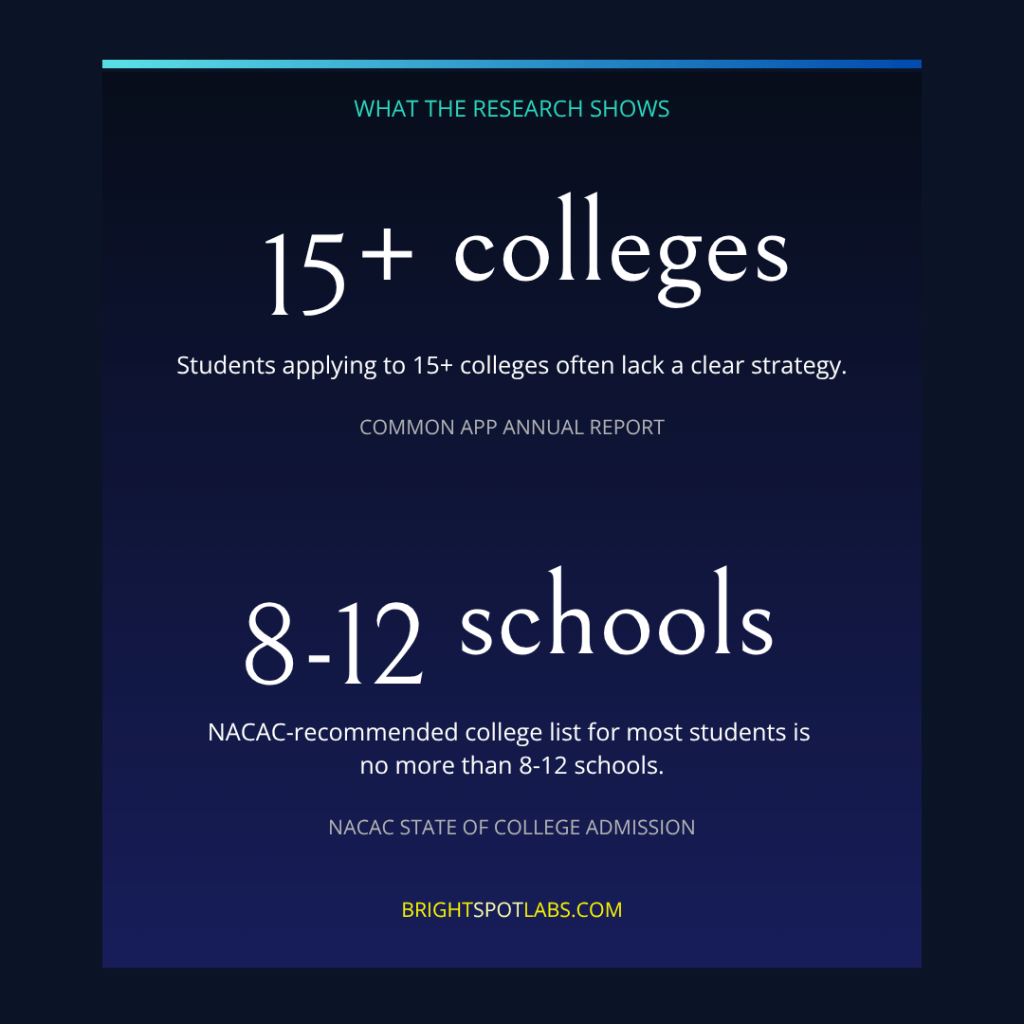
According to Common App’s most recent annual report, the average applicant now submits to more schools than ever before, with many students applying to ten or more colleges without a clear sense of why each one made the list. The volume is not the problem. The lack of strategy is. A college list built around fit, finances, and honest self-knowledge gives students a far better shot at landing somewhere they will actually thrive, not just somewhere that looked impressive on paper.
This post walks through how to build a college list that works, what the research says about the right size and balance, and what most families skip that costs them later.
In This Post
Why the College List Matters More Than the Application
Most families put the bulk of their energy into the application itself: the essays, the activities list, the test scores. Those things matter. But a strong application sent to the wrong schools still produces disappointing outcomes. The college list is where the real work happens, and it deserves far more attention than it typically gets.
The National Association for College Admission Counseling (NACAC) State of College Admission report consistently finds that the factors students and families weigh most heavily when choosing colleges, including academic programs, cost, and location, are often not the factors that drive initial college list building. Instead, name recognition and rankings dominate early decisions. That mismatch is where a lot of families end up somewhere that was never really right.
A well-built college list protects the family at multiple levels. It creates real options in the spring instead of a stressful scramble. It keeps financial aid decisions from becoming a crisis. And it gives the student a genuine choice between schools they actually want to attend, which is the whole point.
What College Fit Actually Means (It Is Not Just Vibes)
The word “fit” gets used a lot in college counseling and rarely gets defined. It is worth being specific. Fit has three real dimensions, and a good college list needs to address all three.
Academic Fit
Academic fit means the student is genuinely prepared for the rigor of the program, and the program offers what they need. A student who is consistently in the bottom quarter of admitted students at a given school may struggle more than they would at a school where they are in the middle or top of the class.
Research from the Brookings Institution on college match has found that students who “undermatch,” meaning they attend schools far below their academic preparation, complete degrees at lower rates than peers with similar credentials who attended more selective institutions. The goal is not always to aim higher. It is to find the right level.
Financial Fit
This is the dimension families most often skip in the early stages and then panic about in the spring. Financial fit means the actual out-of-pocket cost after grants and scholarships is something your family can manage without taking on debt that will destabilize the student’s life after graduation.
The Net Price Calculator, required on every college’s website under federal law, gives families a personalized estimate of what they would actually pay at a given school. This number is almost always different from the sticker price, and sometimes dramatically so. Every school on the college list should be run through the net price calculator before it earns a permanent spot. For a full breakdown of how financial aid packages actually work, see our guide to understanding college financial aid.
Personal and Social Fit
Can the student picture themselves thriving in that environment? A student who needs a small, tight-knit campus will not do their best work at a flagship university with 50,000 undergraduates. A student who wants access to a major city as part of their college experience will not get it from an isolated rural campus, no matter how strong the academics are.
Personal fit includes size, location, campus culture, extracurricular life, and the kinds of students and faculty the school tends to attract. These are not soft considerations. They are the ones that most predict whether a student stays enrolled and finishes.
How to Build a College List: Five Filters to Start With
Before adding a single school name, work through these five filters. They are the structural layer that keeps the college list grounded in reality rather than aspiration.
1. Establish a Real Budget First
How much can your family realistically contribute each year without borrowing beyond what the student can repay within a reasonable window after graduation? A general rule used by financial aid advisors is that total student loan debt at graduation should not exceed the student’s expected first-year salary in their intended field. The Federal Student Aid office publishes average salary data by field, and the Bureau of Labor Statistics Occupational Outlook Handbook gives detailed projections. Run both before you decide what “affordable” means for your family.
2. Narrow by Location Before You Narrow by Name
Geography is a practical constraint that eliminates a large portion of the college universe immediately. Is the student willing to relocate? If so, how far? Do they want access to a city, or is a smaller town fine? Does proximity to home matter for family reasons? Getting clear on geography early keeps the college list from becoming an overwhelming catalog of every school in the country.
3. Define Size and Environment Preferences
Large research universities, mid-size comprehensive schools, and small liberal arts colleges offer genuinely different educational experiences. Class sizes, student-faculty ratios, research opportunities, and advising access vary significantly across these categories. The student should visit or virtually tour at least one school in each category before deciding which environment they are actually looking for.
4. Identify Non-Negotiable Programs
If a student has a specific intended major or career direction, the college list needs to include schools that do that particular thing well, not just schools that are generally well-regarded. A student interested in marine biology, music performance, or nursing should be building around program strength, licensure outcomes, and faculty access in that field, not overall institutional rankings.
5. Check the Student’s Honest Academic Profile
GPA, course rigor, test scores, and extracurricular profile together form the picture that admission offices use. The college list should include schools where the student’s academic profile falls in the middle range of admitted students, not just at the top of it. Admission data is publicly available through the NCES College Navigator, the Common Data Set for each school, and tools like the College Board’s BigFuture. Use actual data, not impressions.
Reach, Match, and Likely: Getting the Balance Right on Your College List
Every college list should include schools across three categories. The right balance is what keeps the spring from becoming a crisis.
Reach schools are ones where the student’s academic profile falls below the middle 50% of admitted students, or where acceptance rates are very low regardless of profile. These are aspirational, and there is nothing wrong with having two or three on the list. The mistake is when the list is mostly reaches with no real floor beneath them.
Match schools are the heart of the college list. These are schools where the student’s academic profile falls squarely within the admitted range, the program exists and is strong, and the student would genuinely be happy attending. This is where most of the list should live, typically four to six schools.
Likely schools are ones where the student is clearly above the middle range and admission is close to certain given a complete, accurate application. Every college list needs at least two, and they should be schools the student would actually attend without hesitation, not just safety nets the student secretly hopes they never have to use. If those schools are on the list only because they are “safe,” the student is not building a real college list. They are building a rejection buffer.
NACAC counselors generally recommend a college list of eight to twelve schools for most students. Fewer than eight limits options in ways that can create real pressure. More than fifteen typically signals that the list lacks strategic focus and the applications will reflect it.

College List Mistakes That Cost Families Later
These are the patterns that show up repeatedly in families who end up with disappointing spring outcomes, significant debt, or a student who transfers out after freshman year.
Building the list around rankings alone. The U.S. News rankings measure certain things, mostly inputs like selectivity and faculty resources, but they are not a reliable indicator of whether a particular student will thrive at a particular school. Pew Research Center data on college value perceptions shows that graduates’ satisfaction with their college experience is far more connected to their sense of belonging and career preparation than to where their school ranked nationally.
Skipping the net price calculator for every school. The gap between sticker price and actual cost can be $20,000 or more per year at schools with strong aid programs. Families who eliminate schools based on published tuition without running the net price calculator are frequently eliminating their best financial options. If you have already received aid offers, our post on how to negotiate college financial aid walks through what to do next.
Not involving the student enough. The college list is the student’s, not the family’s. A student who had no real voice in building the list has no real ownership of the outcome, and that disconnect shows up in motivation, retention, and satisfaction.
Waiting too long to start. Families who begin building the college list in fall of senior year are already behind. The research, campus visits, and honest conversations about fit and finances are junior year work. By the time applications are open, the list should already be stable.
Questions Every Family Should Ask Before Adding a School to the College List
Before a school earns a permanent spot, run it through these questions. If you cannot answer them, that is important information.
- What is the actual net price for a family with our financial profile, based on the school’s net price calculator?
- Where does our student’s academic profile fall relative to the middle 50% of admitted students?
- Does the school have a strong program in the student’s intended area of study, or is it just generally well-regarded?
- What is the four-year graduation rate? (NCES College Navigator has this data for every accredited school in the country.)
- Is this a school the student would actually want to attend without comparing it to anything else on the list?
- Have we visited, toured virtually, or talked to current students or alumni about day-to-day life there?
- What does the financial aid package typically look like, and how does it change after freshman year?
What a Strong College List Actually Looks Like
A strong college list is typically eight to twelve schools. It includes two to three reaches where the student would be genuinely thrilled to attend, four to six well-researched matches where the student fits academically, financially, and personally, and two to three likely schools the student would choose without a second thought. Every school on the list has been through the net price calculator. Every school has a known program in the student’s area of interest. And the student, not just the parents, has meaningful input on every name that made the cut.
That is not a complicated formula. It is just a deliberate one. The families who build college lists this way go into spring with real options, manageable anxiety, and a student who has genuine choices. The families who skip this work tend to find out in April why it mattered.
One important note as you build your list: be careful about letting any college ranking drive the process. Rankings measure a narrow set of institutional inputs and reputation signals, not whether a school is the right fit for your student. Before rank numbers start shaping your list, read our guide on the truth about college rankings and how to use them without getting misled so you go in with a clear picture of what the data does and does not tell you.
BrightSpot Labs Helps Families Build a College List That Works
Building a strong college list takes research, honest conversation, and someone who knows how to ask the right questions at the right time. At BrightSpot Labs, we work with families to build college lists grounded in fit, financial reality, and the specific student in front of us, not a generic formula or a ranking chart.
Whether you are just beginning the college search in sophomore or junior year, or you are a senior who is realizing the list needs a reset, we can help you put together a plan that actually holds up in April.
Connect with BrightSpot Labs today and let us help you build a college list your whole family can feel confident about.
Frequently Asked Questions
How many schools should be on a college list?
NACAC counselors generally recommend 8 to 12 schools for most students. Fewer than 8 limits your options in ways that can create real pressure if acceptances come back differently than expected. More than 15 typically signals that families are adding schools without doing the research needed to know why each one belongs. The goal is a deliberate list, not a long one.
What is the difference between a reach, match, and likely school?
Reach schools are ones where the student’s academic profile falls below the middle 50% of admitted students, or where acceptance rates are very low regardless of profile. Match schools are where the profile falls solidly within the admitted range. Likely schools are where the student is clearly above the typical range and admission is close to certain with a complete application. Every college list needs all three categories to protect the family in the spring.
What does college fit actually mean?
Fit has three real dimensions: academic fit, meaning the student is prepared for the rigor of the program; financial fit, meaning the actual out-of-pocket cost after aid is something the family can sustain without excessive borrowing; and personal and social fit, meaning the student can genuinely picture themselves thriving in that environment. A college list built around all three tends to produce better outcomes than one built around name recognition alone.
When should families start building a college list?
Ideally by the end of sophomore year or the start of junior year. Families who wait until fall of senior year are already behind on the research, campus visits, and financial planning conversations that shape a solid list. The earlier you start exploring what your student actually wants and what you can realistically afford, the less stressful the spring of senior year tends to be for everyone involved.
What are the most common mistakes families make when building a college list?
The patterns that show up most often are: building the list around rankings rather than fit, skipping the net price calculator for each school, not involving the student enough so they have no real ownership of the choices, and starting too late to do genuine research on financial aid potential. Each of these tends to produce the same outcome: a stressful spring with fewer real options and more regret than necessary.
Disclaimer: The information provided by BrightSpot Labs is for general informational and educational purposes only. College planning decisions involve complex financial, academic, and personal factors that vary by family and student. Nothing in this post constitutes financial aid advice, legal guidance, or a guarantee of admission outcomes. Families are encouraged to consult with a certified college counselor, financial aid advisor, or school counselor for guidance tailored to their student’s specific profile and circumstances. BrightSpot Labs is not responsible for outcomes resulting from strategies, advice, or information discussed in this content.