By Antonietta Breitenfeldt, M. Ed. | BrightSpot Labs
Back to school anxiety is one of those things that gets dismissed a little too quickly. Adults tend to normalize it, offer a quick reassurance, and move on. But for a lot of kids, the weeks before school starts and the first few weeks of a new school year involve real, sustained worry that affects their sleep, appetite, mood, and willingness to talk about what is coming. This post is for parents who want to do more than just say “you’ll be fine” and actually give their child something useful to hold onto.
Back to School Anxiety Is More Common Than Most Parents Realize
Anxiety is the most common mental health concern among children and adolescents. The American Psychological Association reports that anxiety disorders affect roughly one in three adolescents at some point before adulthood, and school-related anxiety is one of the most frequent triggers. Even children who do not have a clinical anxiety disorder can experience significant worry around transitions, new grades, new teachers, new social dynamics, and new academic expectations.
The back to school period is particularly loaded because it stacks multiple stressors at once: a change in routine, social uncertainty, academic pressure, and the end of the relative freedom of summer. For some kids, this combination passes within a week or two as the new year settles into a rhythm. For others, the anxiety lingers, compounds, and starts to interfere with daily functioning. Knowing which situation you are dealing with matters.
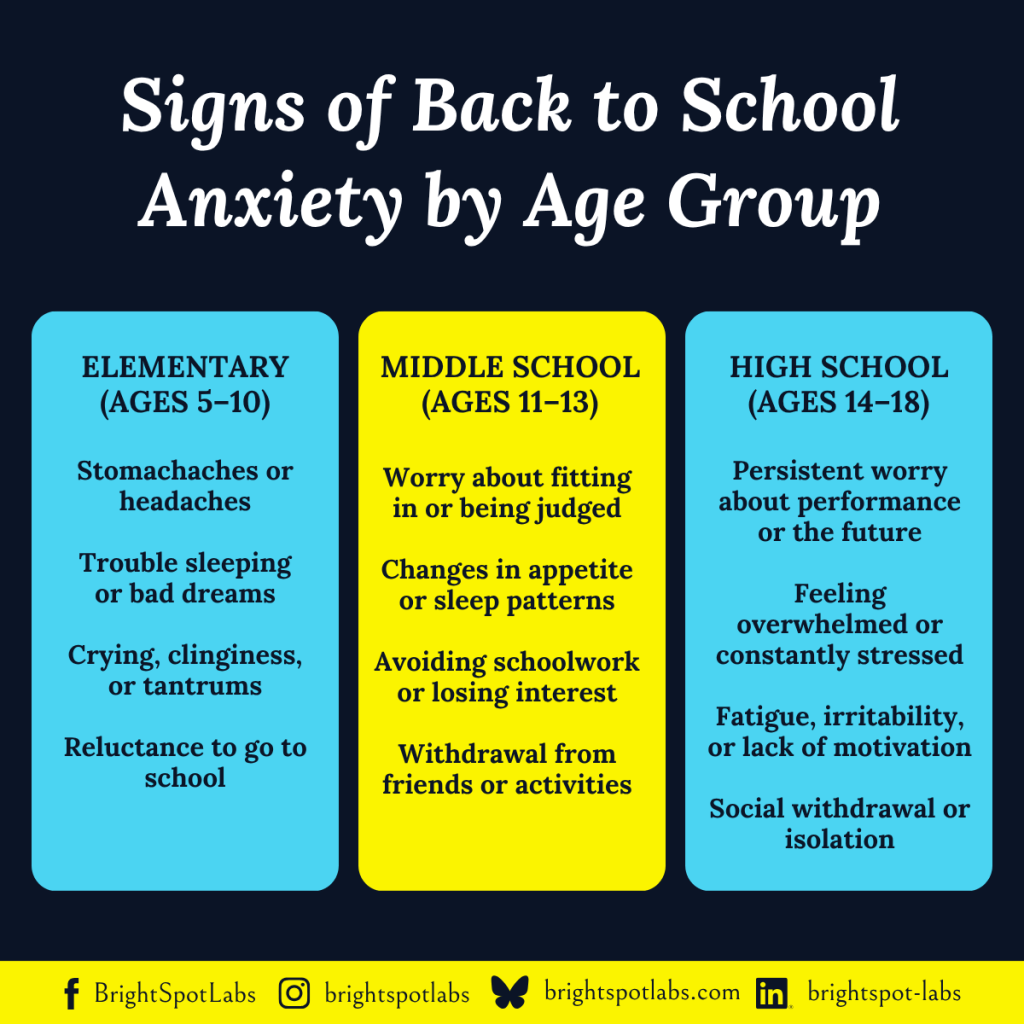
What Back to School Anxiety Looks Like at Different Ages
Anxiety does not look the same across age groups, and parents sometimes miss it because the signs do not match what they expect.
Elementary School (Ages 5 to 10)
Young children often express anxiety physically rather than verbally. Stomachaches and headaches that show up on Sunday nights or Monday mornings are a classic signal. So is clinginess, crying at drop-off, difficulty falling asleep, increased irritability, or regression to younger behaviors like bedwetting or baby talk. A child this age may not be able to say “I’m anxious about school.” They are much more likely to say their stomach hurts or that they just do not want to go.
Middle School (Ages 11 to 13)
The middle school years are often when anxiety becomes more socially focused. Kids at this age are hyperaware of where they fit in, who they will sit with at lunch, whether their friend group has shifted over the summer, and how they will be perceived in a new environment. You might notice your child becoming quieter and more withdrawn, avoiding conversations about school, spending more time on screens to avoid thinking about what is coming, or expressing specific worries about particular friendships or situations.
High School (Ages 14 to 18)
Older teens often carry anxiety about academic performance, college, extracurricular pressure, and identity. Back to school anxiety at the high school level can look like procrastination, resistance to talking about the year ahead, sleep disruption, increased irritability, or a growing avoidance of school activities they used to enjoy. Some high schoolers also minimize what they are experiencing, which makes it harder for parents to spot. A teen who says “I’m fine, leave me alone” may actually be overwhelmed but not have the language or willingness to say so.
8 Things Parents Can Do to Help with Back to School Anxiety
1. Validate the feeling before trying to fix it
The instinct to reassure is understandable, but jumping straight to “you’ll be great, there’s nothing to worry about” often makes anxious kids feel more alone rather than less worried. Their feelings are real to them. Before offering solutions, try simply acknowledging what they are experiencing: “I hear you. Starting a new year is a lot. It makes sense that you feel nervous.” That kind of validation opens the door to a real conversation in a way that dismissal does not.
2. Rebuild the routine before school starts
Anxiety tends to be higher when everything feels uncertain and unpredictable. Rebuilding a school-year sleep schedule, meal routine, and daily structure about one to two weeks before school begins gives children a sense of control and reduces the shock of the first day. The transition from summer to school is easier when the body and mind have already started adjusting.
3. Do a preview run when possible
For younger children especially, visiting the school before the first day, walking the hallways, finding the classroom, and meeting the teacher if possible can reduce the unknown significantly. When kids can visualize where they will be and what it will look like, the anticipatory anxiety tends to drop. Many schools offer orientation days or open houses specifically for this reason, and they are worth prioritizing.
4. Give them a plan for the hard moments
Rather than promising everything will be fine, help your child identify what they can do if they feel overwhelmed during the day. Who is a trusted adult at school they can talk to? What is a strategy they can use when they feel anxious in class, like taking slow breaths or focusing on one task at a time? Having a concrete plan for a hard moment gives children a sense of agency rather than helplessness.
5. Keep goodbyes brief and consistent
Long, drawn-out goodbyes at drop-off tend to signal to children that there is something to worry about. The Child Mind Institute recommends keeping the goodbye ritual warm but short: a hug, a consistent phrase, and a confident departure. If you linger and repeatedly check in, children often pick up on your own anxiety and it amplifies theirs. Projecting calm confidence, even when you do not fully feel it, matters.
6. Create space to decompress after school
Many anxious kids need time to decompress before they can talk about their day. Peppering them with questions the moment they get in the car often produces one-word answers or irritability. Give them 20 to 30 minutes to unwind first. Some kids will open up naturally during a quiet activity like a snack, a walk, or a car ride. Others do better with specific, low-pressure prompts: “What was one okay thing today?” tends to land better than “How was school?”
7. Watch what you project
Children are extraordinarily good at picking up on parental anxiety. If you are openly worried about how your child will do socially or academically, or if you talk about school in tense or uncertain terms, that message lands. This does not mean pretending everything is perfect. It means being mindful about what worries you share and how you talk about school in front of your child.
8. Stay connected to the school
Letting the teacher or school counselor know that your child is struggling with the transition is not overreacting. It is useful information that allows school staff to offer extra support at the right moments, check in with your child, and give you feedback on how things are going during the day when you cannot see it. A brief email at the start of the year goes a long way.

When Back to School Anxiety Needs More Than Parent Support
Most back to school anxiety improves within the first few weeks as routines settle and children adjust. But some situations warrant closer attention. If your child’s anxiety is significantly interfering with sleep, eating, friendships, or their willingness to attend school, if it has not improved after three to four weeks, or if they are expressing intense fear, panic, or physical symptoms on a daily basis, it is worth speaking with your child’s pediatrician or a mental health professional.
The American Academy of Pediatrics recommends consulting with a pediatrician as a first step when parents are concerned about anxiety in school-age children. From there, a referral to a therapist who specializes in childhood anxiety, particularly one trained in cognitive behavioral approaches, is often the most effective next step. School refusal, in particular, is a situation where professional support early makes a significant difference in outcome.
Real Questions Parents Ask About Back to School Anxiety
“My daughter cried every morning for two weeks last year. I don’t know how to handle another year like that.”
Two weeks of morning distress that eventually resolved is actually within the range of what many children experience. The key question is whether it fully resolved or whether it quieted down but never really went away. If her anxiety lingered all year beneath the surface, that is worth addressing proactively rather than waiting to see how this year goes. Start the conversation with her pediatrician before school begins and consider talking with the school counselor at the start of the year so there is support in place from day one.
“My 7th grader says he is fine but he hasn’t slept well in weeks and stopped wanting to hang out with friends.”
Sleep disruption and social withdrawal are two of the more reliable signals that something is going on beneath the surface, especially in a child who says he is fine. Older kids often deflect because they do not want to worry their parents or because they are not sure how to name what they are feeling. Rather than pushing for a direct conversation about anxiety, try low-key connection: watching something together, taking a drive, doing something side by side. Kids often open up when they are not facing you directly. If this pattern persists into the school year, talking with a school counselor or therapist is worth considering.
“Is it okay to let my child stay home if they are really struggling on a particular morning?”
Occasionally, and for a genuine reason, yes. But repeated avoidance tends to make anxiety worse, not better. Each time a child avoids the thing they fear, the anxiety grows a little stronger because the avoidance confirms that there was something to fear in the first place. If your child is asking to stay home frequently, that is a pattern that usually needs professional support rather than continued accommodation. The goal is helping them learn to manage the feeling rather than avoid the situation.
What You Might Be Missing
Most back to school anxiety advice focuses on the weeks right before and after school starts. But there are a few less obvious pieces that matter a lot.
Last year’s experience sets the stage. If your child had a hard social or academic experience the previous year, their anxiety this fall is not just about the unknown. It is about the known: returning to a place where something painful happened. That requires a different kind of conversation and sometimes a different kind of support than general transition anxiety.
Academic anxiety and social anxiety often travel together. A child who is worried about being behind in math is often also worried about how classmates perceive them when they struggle. A child who is nervous about making friends is often also more sensitive to academic pressure. Addressing one without acknowledging the other leaves part of the picture unaddressed.
Your child’s coping skills matter as much as your support. What you do as a parent is important, but ultimately your child also needs their own toolkit. That includes age-appropriate strategies for managing worry, the ability to identify trusted adults at school, and practice tolerating discomfort rather than always avoiding it. Building those skills takes time and consistency, and it is something that can be worked on with a therapist, school counselor, or academic coach.
Anxiety that starts in August can show up in October as academic struggle. Kids who are spending mental energy managing anxiety have less available for focusing, retaining information, and completing work. If your child’s grades drop in the first marking period, anxiety from the start of the year may be a contributing factor worth exploring, not just a motivation or effort problem.
How BrightSpot Labs Supports Students and Families Through School Transitions
At BrightSpot Labs, we work with students who are navigating anxiety alongside academic demands, often because the two are connected in ways that are hard to separate. Our academic coaching and executive function support help students build the organizational skills, confidence, and day-to-day coping strategies that make school feel more manageable. When students feel competent and prepared, anxiety has less to hold onto.
We also help parents think through what their child needs and how to advocate for it effectively at school. If you are heading into a new school year with real concerns about your child’s anxiety and how it will affect their learning, we are glad to talk it through.
Frequently Asked Questions
What are the signs that my child has back to school anxiety and not just normal first-day nerves?
Normal first-day nerves tend to settle quickly once the routine kicks in. Back to school anxiety is more persistent and often shows up in physical symptoms (stomachaches, headaches), behavioral changes (clinginess, irritability, sleep problems), or outright school refusal. If the distress continues beyond the first two weeks or is severe enough to interfere with daily life, that is a signal worth taking seriously.
How early should I start preparing my child for going back to school?
Start rebuilding the school-year routine about one to two weeks before the first day. Shift sleep schedules gradually, restore regular meal times, and talk about what to expect. For kids who struggled the year before, a preview visit to the school or a conversation with the teacher beforehand can also make a real difference in reducing the fear of the unknown.
Is it okay to let my child stay home if they are really struggling on a difficult morning?
Occasionally and for a genuine reason, yes. But repeated avoidance tends to make anxiety worse over time. Each time a child avoids the thing they fear, the anxiety grows stronger because avoidance confirms to their brain that the situation is dangerous. The goal is to build the child’s ability to tolerate discomfort, not to eliminate the hard moments entirely.
My child says they’re fine but hasn’t slept well in weeks and stopped hanging out with friends. Should I be concerned?
Yes. Sleep disruption and social withdrawal are two of the more reliable signals that something is happening beneath the surface. Older kids especially tend to deflect because they do not want to worry their parents or they cannot identify exactly what is wrong. These behavioral changes are worth a gentle, low-pressure conversation and possibly a check-in with a school counselor.
When does back to school anxiety need professional support?
If anxiety is significantly interfering with sleep, eating, friendships, or your child’s ability to get through the school day after several weeks, a conversation with your pediatrician or a licensed therapist is the right next step. The American Academy of Pediatrics recommends cognitive behavioral therapy as a first-line treatment for anxiety in children and teens, and early support tends to produce better outcomes than waiting.
Disclaimer: The information provided by BrightSpot Labs is for general informational and educational purposes only. This content is not a substitute for advice from a licensed mental health professional, pediatrician, or school counselor. If your child is experiencing significant anxiety that is interfering with their daily functioning, please consult with a qualified professional. BrightSpot Labs is not responsible for outcomes resulting from strategies, advice, or information discussed in this content.