By Antonietta Breitenfeldt, M. Ed. | BrightSpot Labs
The summer between 8th and 9th grade can feel deceptively calm. Your kid just finished middle school, maybe they had a good year or maybe it was a rough one, but either way you are thinking: high school, fresh start. Then September arrives and suddenly the rules have changed in ways nobody warned you about. The middle school to high school transition is one of the biggest academic and social shifts students face before college, and for most families it sneaks up quietly. This post covers 9 things every parent should know before their child makes this switch, so you can support them without hovering and without waiting for a crisis to appear.
Why the Middle School to High School Transition Hits Differently
Most parents remember high school as just harder than middle school. That is true, but it undersells what is actually happening developmentally and academically at the same time.
Research from the National Longitudinal Study of Adolescent to Adult Health shows that 9th grade is one of the highest-risk years for academic disengagement. Students who struggle during the middle school to high school transition are significantly more likely to fall off track for graduation. A study published in the Journal of Educational Psychology found that students who feel socially disconnected in their first year of high school show measurably lower academic performance, even when they were strong students before. The American Academy of Pediatrics has also published consistent guidance on how this transition period affects both physical health and cognitive performance in adolescents.
The shift is not just about harder classes. It is about a fundamentally different environment where students are expected to advocate for themselves, manage their own time, and navigate a much larger social landscape, often with less direct adult support than they have ever had before.
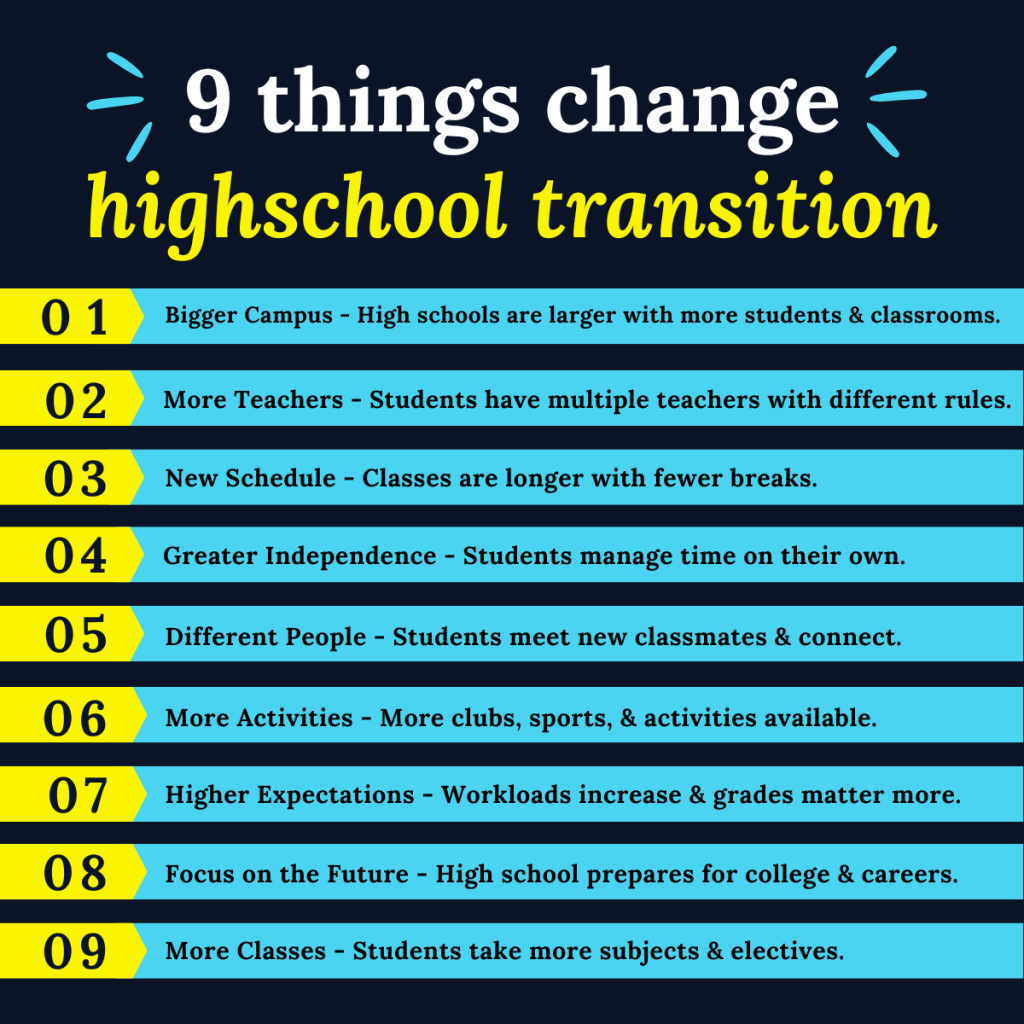
9 Things That Actually Change During This Transition
1. Grades count in an entirely new way
In middle school, many districts use grades primarily for feedback. In high school, those grades go on a permanent transcript that colleges and scholarship committees will review. A rough 9th grade year is not the end of the world, but it does matter, and most students do not understand that until it has already happened.
2. The schedule gets significantly more complex
Block scheduling, elective choices, honors and AP tracks, extracurricular commitments layered on top of coursework. Students who glided through middle school on memory and last-minute effort often hit a wall when the volume increases and the expectation shifts to sustained work over time.
3. Teachers expect far more independence
Middle school teachers typically send reminders, follow up with families, and check in frequently. High school teachers, especially in honors or AP classes, assume that if a student needs help, they will ask for it. Many students who have never had to advocate for themselves simply do not know how to start.
4. Social dynamics shift in unexpected ways
The friend groups that felt solid in 8th grade sometimes fracture. New students join from other middle schools. Kids who were confident in a smaller environment can feel invisible in a larger one. The reverse is also true: some students who struggled socially in middle school finally find their people through high school extracurriculars.
5. Sleep and schedule pressure collide
High school start times are often earlier, while adolescent biology pushes teens toward later sleep cycles. The American Academy of Pediatrics endorses recommendations that adolescents get 8 to 10 hours of sleep per night. Chronic sleep deprivation can affect mood, attention, learning, memory, and executive functioning. The transition from middle school to high school can make the sleep problem worse before families recognize it.
6. Transcript strategy begins now, not later
Colleges look at the entire high school transcript. The classes your child takes in 9th grade, and how they perform, set the foundation for what they will have access to in 10th and 11th grade. Honors in 9th grade typically opens the door to AP courses later. Understanding the course progression at your specific school before 9th grade begins is worth the effort.
7. Executive function gaps become more visible
Moving from a structured middle school day to one with more unstructured work time catches a lot of students off guard. They do not have a system for prioritizing tasks, breaking large assignments into steps, or managing distractions. According to research from the American Psychological Association, the prefrontal cortex, which handles planning and decision-making, is still actively developing through the mid-20s. These skills need to be taught explicitly, not assumed.
8. Help-seeking behavior drops sharply
Research on adolescent help-seeking behavior (Karabenick and Knapp, 1991, updated by multiple subsequent studies) is consistent: the perceived social cost of asking for help is highest during early adolescence. Students would rather underperform than be seen asking. Normalizing academic support before there is a crisis makes a real difference. Students who access coaching or tutoring proactively tend to recover faster and build more lasting habits.
9. Identity development is happening under the surface
Your child is not just switching schools. They are continuing to develop their identities. Research on adolescent identity development, rooted in Erik Erikson’s foundational work and expanded by more recent studies in developmental psychology, consistently shows that the high school years are when identity consolidation happens most intensively. The question “who am I?” is not abstract for a 9th grader. It runs underneath every academic and social experience they are having.
Real Situations Parents Search for Help With
“My daughter was a straight-A student in middle school and is now failing 9th grade English.”
This is one of the most common concerns we hear at BrightSpot Labs. What often happens is that middle school rewards effort and completion, while high school rewards analysis, synthesis, and independent thinking. This is not a sign that something is wrong with your daughter. It is a signal that she needs targeted support building those specific skills now, before the gap widens.
“My son says he’s fine but his grades say otherwise. He refuses to ask for help.”
This is almost textbook for 9th grade. The middle school to high school transition surfaces a pattern where students would rather underperform than be seen asking for help, especially in a new and larger environment where they are still figuring out their social standing. Students who access support proactively tend to do significantly better.
“My 9th grader says she hates school now. She loved it in middle school.”
It depends. Social disconnection in early high school is worth paying attention to. But “hating school” is also a very normal response to a system that suddenly feels unfamiliar and less personal. The question to ask is whether it is situational or chronic. If it has been more than one semester and nothing has improved, that is worth addressing directly.
Practical Tips for the Middle School to High School Transition
Start the conversation in the summer, not in October. Talk openly about what is changing before it changes. What is your child most nervous about? What are they excited about? You just need to open the door and keep it open.
Tour the school before the first day. Many high schools offer freshman orientation, but even walking the building beforehand reduces first-day anxiety significantly.
Help them build a simple organization system, then step back. Whether it is a paper planner, Google Calendar, or a task app, help them set up something that works for them. The goal is for them to own it.
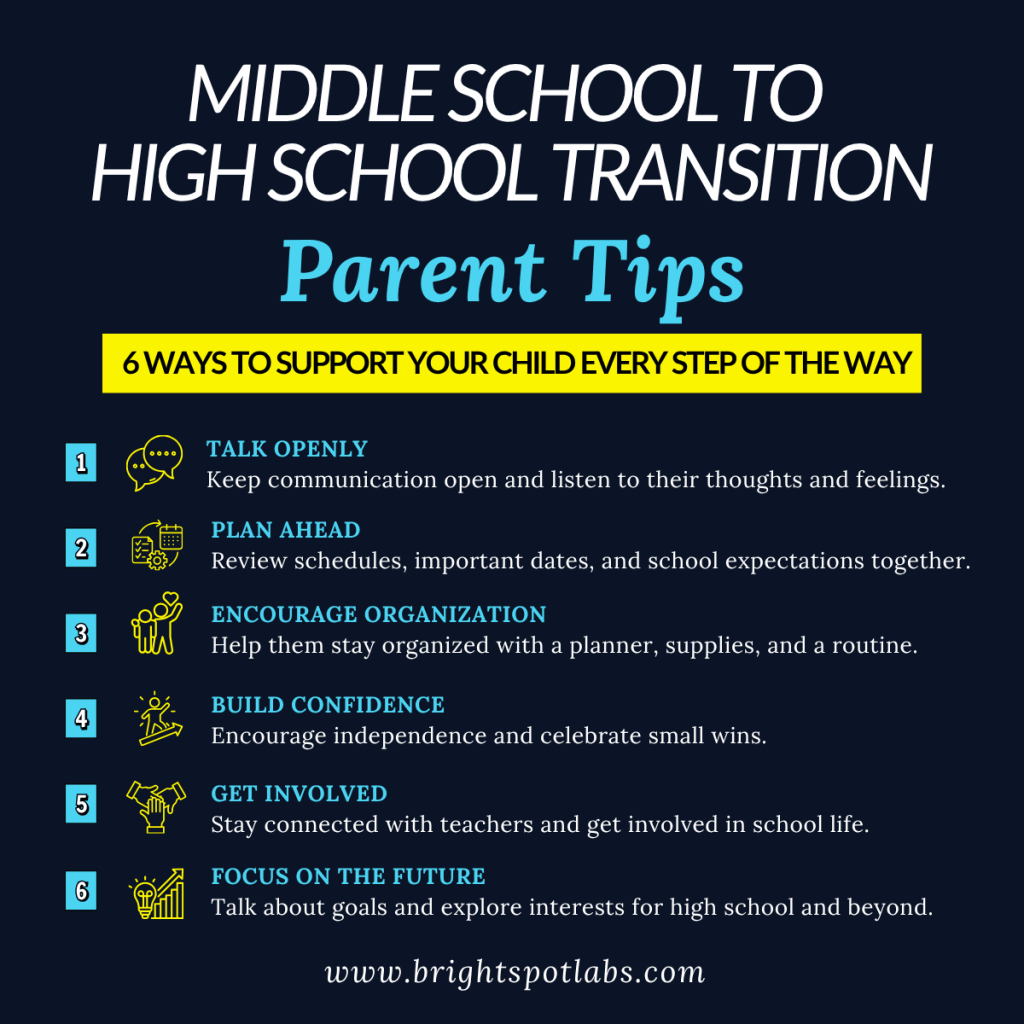
Stay connected to the school without hovering. Sign up for the school newsletter, check the parent portal regularly, but do not read every teacher comment aloud at dinner. Your role shifts from manager to consultant.
Watch for warning signs. Grades that do not recover after the first marking period, withdrawal from activities they used to enjoy, increased anxiety, or patterns of school avoidance. Several together, or any that persist well past the first semester, are worth addressing.
Consider proactive academic support. Waiting until grades are critically low before getting help is one of the most common mistakes families make during the middle school to high school transition. Students who access support in 9th grade, before they have fallen significantly behind, have much better outcomes than those who try to repair the damage later.
The Emotional Side Nobody Warns You About
Stay curious rather than prescriptive. Ask open questions. “What was the best part of your day?” is more useful than “Did you talk to anyone at lunch?” The goal is to keep the connection open so that when something is genuinely hard, they already have the habit of talking to you about it.
If your child’s friend group from middle school fractures in high school, that is painful. Acknowledge that it is hard while also pointing to the fact that new friendships are possible. And your own anxiety about the middle school to high school transition is contagious. Managing your worries separately from conversations with your child protects them more than you might expect.
How BrightSpot Labs Can Help
At BrightSpot Labs, we work with students and families through exactly this kind of transition. Whether your child needs academic coaching to build the skills high school demands, support with time management and organization, or a thinking partner for course selection and early planning, we meet students where they are and build from there.
If you are not sure whether your child needs support, reach out anyway. A conversation is free and almost always clarifying. You do not have to wait for a crisis to start asking the right questions. If you are still in the planning phase, our post on the most common mistakes parents make when planning for high school covers the course selection and extracurricular decisions that shape how the transition actually goes.
Learn more about our services at BrightSpot Labs.
Frequently Asked Questions
What changes most when a student moves from middle school to high school?
Grades go on a permanent transcript, teachers expect more independence, the schedule gets significantly more complex, and social dynamics shift all at once. It is a bigger adjustment than most families expect.
Why do some students who did well in middle school struggle in 9th grade?
Middle school often rewards effort and completion. High school rewards analysis, independence, and self-advocacy. Students who relied on the structure and frequent reminders of middle school often hit a wall in 9th grade.
How can parents support their child during this transition without hovering?
Ask open questions rather than checking grades every day. Help your child build an organizational system, then let them manage it. Your role shifts from manager to coach during the high school transition.
When should a parent consider getting academic support for their 9th grader?
If grades do not recover after the first marking period, or if you notice withdrawal, increased anxiety, or school avoidance, those are signs worth acting on. Do not wait for a crisis before reaching out for support.
What are the warning signs that a student is struggling during the high school transition?
Grades that stay low past the first marking period, withdrawal from activities they used to enjoy, increased anxiety about school, and refusing to ask for help are all early warning signs worth paying attention to.
Disclaimer: The information provided by BrightSpot Labs is for general informational and educational purposes only. This content is not intended to serve as a substitute for advice from a licensed school counselor, educational psychologist, or academic specialist. Every student adjusts to the middle school to high school transition differently, and strategies that work for one child may not work for another. If you have significant concerns about your child’s academic performance, social adjustment, or emotional well-being, we encourage you to consult directly with a qualified professional. BrightSpot Labs is not responsible for outcomes resulting from strategies, advice, or information discussed in this content.