By Antonietta Breitenfeldt, M. Ed. | BrightSpot Labs
College planning for parents almost always starts with the same question: “What schools should we look at?”
It sounds like a reasonable place to begin. But here is the problem. A school list is a byproduct of a solid strategy, not a starting point. Families who lead with the list often end up chasing rankings, spending tens of thousands of dollars more than they needed to, and second-guessing every decision, all because they never stopped to ask what actually fits their student and their family.
The stakes are real. Student loan debt in the United States now sits at $1.84 trillion, spread across 42.8 million borrowers. The average borrower carries roughly $43,570 in combined federal and private loan debt, according to Education Data Initiative. That number does not materialize overnight. It is the result of families making enormous financial decisions without enough information, or without a clear plan.
The good news is that starting with the right framework changes everything. Families who approach this process strategically, starting in the early high school years, consistently end up with better options, less stress, and decisions they feel genuinely confident about. This guide walks through the five essential steps those families start with, so you can do the same.
Table of Contents
- Step 1: Start With Your Student, Not a School List
- Step 2: Understand What Colleges Are Actually Looking For
- Step 3: Get Clear on the Real Numbers Before You Fall for a School
- Step 4: Map Out a Realistic Timeline by Grade
- Step 5: Factor In the World Your Student Is Graduating Into
- What to Do Right Now
- Work With BrightSpot Labs
Step 1: Start With Your Student, Not a School List
Before a single college name gets written down, families who navigate this process well ask a different set of questions. Not “what schools are good?” but “what does good actually mean for this specific student?”
This matters more than it sounds. College fit is not a vague concept. It is the intersection of your student’s academic strengths, personal interests, learning style, preferred environment, and your family’s financial picture. A school that works beautifully for one student can be a poor fit for another with nearly identical grades, because the environment, culture, and career pathways are entirely different.
Here is what confident families actually do at this stage.
They define what success looks like for their student, not for the family résumé. This means having honest conversations about what your student genuinely cares about, what kind of environment helps them thrive, and what they want their next four years to look and feel like. Not what looks impressive. What actually fits.
They separate fit from reach. These are not the same thing. A reach school is one where your student’s stats are below the median for admitted students. A fit school is one where your student would genuinely thrive academically, socially, and financially. Many families spend all their energy on reach schools and end up overlooking strong-fit schools that would serve their student far better.
They resist the rankings trap early. National rankings measure research output, endowment size, and selectivity. They do not measure whether your student will have access to mentors, whether the career placement rate in their field is strong, or whether the campus culture is a match. Rankings are a starting point at best and a distraction at worst.
They build a values-based list, not a prestige-based one. When families start with values and fit criteria, the school list that emerges is almost always more manageable, more realistic, and more likely to result in a decision everyone feels good about.
If you are not sure how to get this conversation started, our post on education planning for parents offers a helpful broader framework for thinking about your child’s K-12 path and what it is building toward.
Step 2: Understand What Colleges Are Actually Looking For
One of the most common and costly misconceptions in college planning is that admission is primarily about GPA. It matters, yes. But the full picture is more layered, and understanding it early changes how you and your student make decisions throughout high school.
Academic Performance Still Leads
Your student’s transcript is the single most important document in a college application. GPA, course rigor, and grade trends all matter. According to research compiled by Great College Advice, grades and course rigor are the top factors colleges evaluate. A strong GPA in challenging courses outperforms a perfect GPA in easier ones because admissions offices want to see that your student can handle college-level work.
This is why ninth grade matters more than most families realize. The transcript clock starts on day one of freshman year.
Extracurriculars: Depth Over Volume
Common Data Set data from top-ranked U.S. colleges shows that 88% consider extracurricular involvement “Important” or “Very Important” in the admissions process. But here is what that data does not say: more activities is not better. What admissions readers look for is depth of commitment, demonstrated growth, and authentic interest.
This is the critical difference between a busy student and a prepared student. A student involved in three or four activities consistently over multiple years, ideally with increasing responsibility or leadership, tells a far stronger story than one with a long list of clubs joined for a semester each.
Piling on activities to build a résumé is one of the most common mistakes families make in high school planning. It creates stress, it dilutes impact, and it often backfires. A student who genuinely loves what they are doing comes through clearly in essays, interviews, and letters of recommendation.
Essays Are Not Optional
More than 56% of colleges report that the personal statement carries “considerable” or “moderate” importance in their review process. At selective schools, where many applicants are academically similar, the essay becomes a genuine differentiator.
The best college essays do not summarize the résumé. They reveal who the student is. What they think about, how they see the world, what they have learned from something difficult they worked through. That kind of self-awareness takes time to develop, which is one more reason starting the planning process early matters.
Recommendations and Relationships
Strong letters of recommendation come from teachers and counselors who know your student well. That relationship is built over time. A teacher who has seen your student struggle through a hard concept and push through it will write a very different letter than one who only knows them by name and grade.
Schools also review the context of where your student went to school, what resources were available to them, and what the typical student at that school looks like. Admissions is holistic in ways that reward real engagement, not performance.

Step 3: Get Clear on the Real Numbers Before You Fall for a School
This step is where the most avoidable pain in the college process lives. Families fall in love with a school, their student applies, gets accepted, and then the financial aid package arrives and it does not work. The conversation that should have happened in sophomore year is now happening in April of senior year under enormous pressure.
Understanding the financial landscape early is not pessimistic. It is one of the most protective things you can do for your family.
Sticker Price vs. Net Price
The sticker price of a college is almost never what families actually pay, but the difference between sticker and actual cost varies dramatically from school to school. Some schools with high sticker prices offer generous merit aid that brings the net price well below what a seemingly cheaper school might actually cost. Others with lower sticker prices offer little aid and end up being more expensive in practice.
Comparing net price, not sticker price, is the only financial comparison that matters. Net Price Calculators are available on every college’s website and give families a rough estimate of actual cost based on income and assets. Use them before your student falls in love with a school.
Understanding FAFSA and Financial Aid
The Free Application for Federal Student Aid opens every October 1 for the following academic year. Filing early matters because some aid is distributed on a first-come basis. The FAFSA determines your Student Aid Index, which is what the federal government calculates your family can reasonably contribute toward college costs.
Many private colleges also require the CSS Profile, which looks at a broader picture of family finances including home equity and retirement assets. Understanding both processes and how your family’s situation will be evaluated, before your student applies, gives you time to plan instead of react.
For a detailed walkthrough of how financial aid actually works, including grants, loans, and scholarships, our post on understanding college financial aid breaks it all down in plain language.
You Can Negotiate Your Aid Package
What most families do not know is that financial aid offers are frequently negotiable. If your student receives an offer that does not reflect your family’s actual financial situation, or if a competing school has offered significantly more, you can write an appeal. This is called a Professional Judgment Request, and it is a standard part of the process that financial aid offices fully expect.
Some families save thousands of dollars through this process alone. We cover exactly how to approach it in our post on negotiating college financial aid.
Start the Scholarship Search Early
Private scholarships are an often-overlooked piece of the funding picture. They take time and effort to find and apply for, but they can meaningfully reduce what your family needs to borrow. The key is starting the search early, ideally in sophomore or junior year, so that deadlines are not missed and applications are not rushed.
BrightSpot Labs maintains a regularly updated list of scholarships for students at every level. You can find it here: The Ultimate Guide to College Scholarships.
What the Debt Numbers Actually Mean for Your Family
The $1.84 trillion in outstanding student loan debt in this country is not an abstraction. It represents real families making real decisions, often under time pressure, without a full picture of what they were committing to. The average borrower carrying $43,570 in debt upon graduation is not someone who made a reckless choice. In many cases, it is someone who planned reactively instead of proactively.
Knowing the numbers in sophomore or junior year does not limit your student’s options. It sharpens them.
Step 4: Map Out a Realistic Timeline by Grade
College planning is not something that happens in a single year. The families who feel most prepared at the end are the ones who treated it as a multi-year process, taking small and deliberate steps at each stage rather than trying to compress everything into senior year.
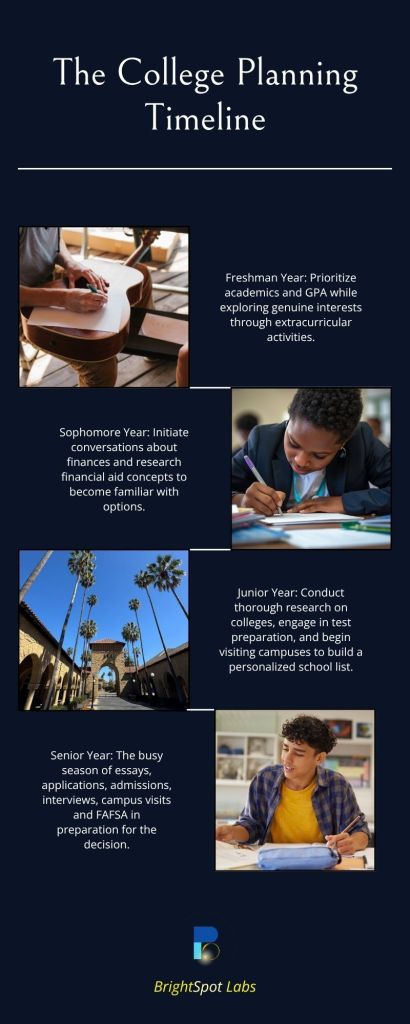
Here is a grade-by-grade framework to work from. Adjust it based on your student’s specific situation, but use it as a baseline for what to focus on when.
Freshman Year: Build the Foundation
Freshman year is not too early to think about college, but it is absolutely not the time to obsess over school lists. The most important work happening in ninth grade is academic foundation-building.
GPA established in freshman year follows your student through the entire application process. Encourage appropriately challenging coursework, get support early if your student is struggling in any subject, and let them explore genuine interests without pressure to curate a résumé. Authenticity at this stage beats strategy every time.
This is also a good year for parents to start educating themselves on financial aid basics, so the concepts are familiar when the numbers start to matter more in later years.
Sophomore Year: Build Awareness
In sophomore year, the conversation can start to expand. Help your student identify the activities and interests they want to commit to more deeply. Encourage leadership opportunities in areas they already care about rather than adding new activities for the sake of the application.
This is also the right time to begin having realistic financial conversations as a family. What can you reasonably contribute? What are your expectations around borrowing? What does financial fit look like for your household? These conversations are far less stressful in sophomore year than in April of senior year when a decision is due in days.
Some students begin standardized test prep in the second half of sophomore year. Whether that makes sense depends on the student’s goals and the schools on their eventual list.
Junior Year: The Planning Ramp-Up
Junior year is where the real work begins. By fall, your student should be actively researching colleges, not just browsing websites but genuinely evaluating whether schools match the criteria your family has defined. What are the outcomes for students in their area of interest? What does the financial aid history look like for families in your income range? What is the campus culture actually like?
Key junior year priorities include standardized testing (if applicable), building out the college list by spring, visiting campuses where possible, and beginning to think about the personal statement. Many students start drafting essays over the summer between junior and senior year, which takes enormous pressure off the fall application season. A big part of that is knowing exactly what is due and when. Our guide to college application deadlines covers every key date from August through May 1, so nothing catches your family off guard.
This is also the year to run each school’s net price calculator and begin a side-by-side financial comparison. Do not wait until the acceptance letters arrive to think about what you can afford.
Senior Year: Execute the Plan
For families who prepared in earlier years, senior year is hard work but not a crisis. The major milestones are application deadlines (which vary by school and application type), the FAFSA opening on October 1, the CSS Profile for schools that require it, and financial aid award letters arriving in late winter and early spring.
By the time National College Decision Day arrives on May 1, families who planned ahead have real options and can make a final decision from a position of clarity rather than pressure. If your student ends up facing rejections during this process, our post on helping your child through college rejection offers practical guidance on how to support them and move forward with confidence.
Step 5: Factor In the World Your Student Is Graduating Into
This final step is one many families skip entirely, and it is the one that connects every other decision to the bigger picture: what is the world your student is actually going to graduate into, and how does that shape which school and which path makes the most sense for them?
The Workforce Is Changing Faster Than Most People Realize
According to the World Economic Forum’s Future of Jobs Report, 60% of employers expect digital skills, AI literacy, and adaptability to be among the most critical employee attributes in the years ahead. Roles that did not exist ten years ago are now among the fastest-growing career fields. Roles that looked stable a decade ago are shrinking.
This does not mean every student should major in technology. It means that when you evaluate colleges, questions about career services, internship pipelines, alumni networks, and industry partnerships deserve as much attention as questions about campus life and housing options.
Return on Investment Varies Significantly by School
The Georgetown Center on Education and the Workforce ranks over 4,600 colleges by return on investment, and the range is significant. Two students can graduate with degrees in the same field, spend roughly the same amount on their education, and end up in dramatically different financial positions based on which school they attended and what career support resources were available to them.
This is not an argument against college. College graduates broadly still out-earn non-graduates over the course of their careers. But it is an argument against treating all colleges as interchangeable. Strategic selection, based on ROI data alongside fit criteria, is how families set students up for long-term success rather than short-term prestige.
Talk About the Future Before You Build the List
Your student does not need to know exactly what they want to be at seventeen. But having a general sense of the direction they are moving, the kinds of problems they want to solve, the environments they want to work in, can meaningfully shape which colleges belong on their list and which ones are a poor investment regardless of name recognition.
Some of the most important conversations in college planning are not about college at all. They are about what kind of life your student is trying to build and what kind of support, environment, and resources they need to get there.
What to Do Right Now
If you are reading this as a parent of a high schooler and feeling behind, here is the most useful thing you can do: stop trying to do everything at once and start with the step that fits where you are.
If your student is a freshman or sophomore, sit down together and have an honest conversation about what they genuinely care about. Not what looks good on paper. What matters to them. Then take stock of where they are academically and what your family’s financial picture looks like. You have time to build toward this intentionally.
If your student is a junior, the timeline is tighter but not closed. Get the school list started, run the net price calculators, and start talking seriously about finances. A junior year with a clear plan is far better than a senior year in reactive mode.
If your student is a senior and things feel chaotic, most families have been exactly where you are. Focus on the deadlines in front of you, be honest with your student about finances, and remember that the right school is the one that genuinely fits, not the one with the most name recognition.
Whatever stage you are in, the goal is the same: move from reactive to intentional. That shift alone makes an enormous difference.
Work With BrightSpot Labs – College Planning for Parents
College planning is one of the biggest decisions a family will make, and trying to figure it all out alone often leads to costly detours, missed deadlines, and a lot of unnecessary stress. At BrightSpot Labs, we work directly with families to build individualized, strategic plans that account for your student’s strengths, your family’s priorities, and the real landscape of college admissions today.
Whether you are just starting this process or you are mid-stream and need a clearer direction, we can help you get there with confidence. If you have another student coming up through high school, now is the right time to get ahead of it rather than catch up to it.
Book a consultation with our team and get a clear picture of exactly where to start.
Disclaimer: The information provided by BrightSpot Labs is for general informational and educational purposes only. This content does not constitute financial or legal advice. Families navigating college financing decisions should consult with a qualified financial advisor. For personalized guidance on the college planning process, families are encouraged to work with a qualified educational consultant or school counselor. BrightSpot Labs is not responsible for outcomes resulting from strategies, advice, or information discussed in this content.