By Antonietta Breitenfeldt, M. Ed. | BrightSpot Labs
Summer is supposed to feel different. Looser schedules, slower mornings, time to breathe. But for a lot of families, it also comes with a quiet anxiety: how do we keep the kids engaged without losing everything they learned this year? The answer is not a workbook on the kitchen table or a rigid schedule that turns your home into a second classroom. The best summer learning activities for kids look nothing like school, and that is exactly the point.
Research consistently shows that students can lose significant academic ground over summer. NWEA, which tracks learning data from millions of students through the MAP Growth assessment, finds that the average student scores lower in math and reading at the start of the school year than they did at the end of spring.
This guide is for parents who want both. Learning that sticks, and a summer that does not burn anyone out.
In This Post
What Summer Learning Actually Means (It Is Not School at Home)
The biggest mistake families make is trying to replicate the classroom during summer break. Worksheets, reading logs with charts, and timed math drills might feel productive, but they often create resistance and resentment, especially in kids who just spent nine months doing exactly that.
Real summer learning looks like your child negotiating who gets which role in a backyard game. It looks like measuring ingredients for a recipe they chose. It looks like getting into an argument with a sibling, working it out, and moving on. The American Academy of Pediatrics has long held that unstructured and child-directed play builds the executive function, emotional regulation, and social skills that no worksheet can replicate.
Summer learning is not about doing more. It is about doing differently.
Signs Your Child Is Already Burning Out
Before you build any summer plan, it helps to know what burnout actually looks like in kids. It is not always meltdowns and refusals. Sometimes it is quieter than that.
- They resist anything that feels like learning, even things they used to enjoy
- They seem flat, bored, or disconnected even during downtime
- They are irritable or emotional in ways that feel out of proportion
- They have stopped talking about school friends or activities they used to mention
- They physically drag through the day even after a full night of sleep
If any of these sound familiar, the first step is rest, not more programming. A child who is running on empty will not absorb much of anything, no matter how enriching the activity.
Summer Learning Activities for Kids: PreK through Kindergarten
At this age, play is not a break from learning. Play is the learning. Children ages 3 through 6 are wiring their brains for language, emotional recognition, and physical coordination at a rate that will never happen again. The best thing you can do is get out of the way and play alongside them.
What the Research Says
A landmark Harvard Graduate School of Education report found that free play in summer supports social, emotional, and academic development simultaneously. Children who had more unstructured outdoor time showed stronger language development, better conflict resolution, and higher emotional resilience heading into the school year.
Activities to Try
- Mud kitchen or sensory play: Fill a bin with dirt, water, rocks, and leaves. Let them cook, sort, and build. This builds fine motor skills and creative thinking with zero adult direction needed.
- Neighborhood nature walks with a journal: Pick up a blank sketchbook from a dollar store. Walk the block and let your child draw or describe one thing they notice each day. Over summer, this becomes a record they made themselves.
- Pretend play with real props: Set up a “store” using canned goods from the pantry. Let them be the cashier, the customer, and the stocker. This naturally builds number sense, language, and turn-taking.
- Read-aloud every single day: Even 10 minutes of reading aloud at this age has compounding effects on vocabulary and listening comprehension. Let them pick the book, even if it is the same one for the fifteenth time.
- Cooking simple recipes together: Measuring, pouring, and stirring are early math in action. Talking about what is happening builds science vocabulary naturally.
Social and emotional focus for this age: Taking turns, naming feelings, asking for help, and learning that other people have different ideas. These are the skills that kindergarten teachers say matter most when kids arrive in September.

Summer Learning Activities for Kids: Grades 1 through 5
Elementary-age kids are ready for a little more structure, but only if it feels like their idea. The key for this group is giving them real problems to solve and real choices to make. Responsibility and ownership are powerful learning tools at this stage.
What the Research Says
CASEL, the Collaborative for Academic, Social, and Emotional Learning, identifies self-management and responsible decision-making as two of the core competencies children develop between ages 6 and 11. Summer is actually the ideal time to practice these because the stakes are lower and the opportunities are more authentic than a classroom exercise.
Activities to Try
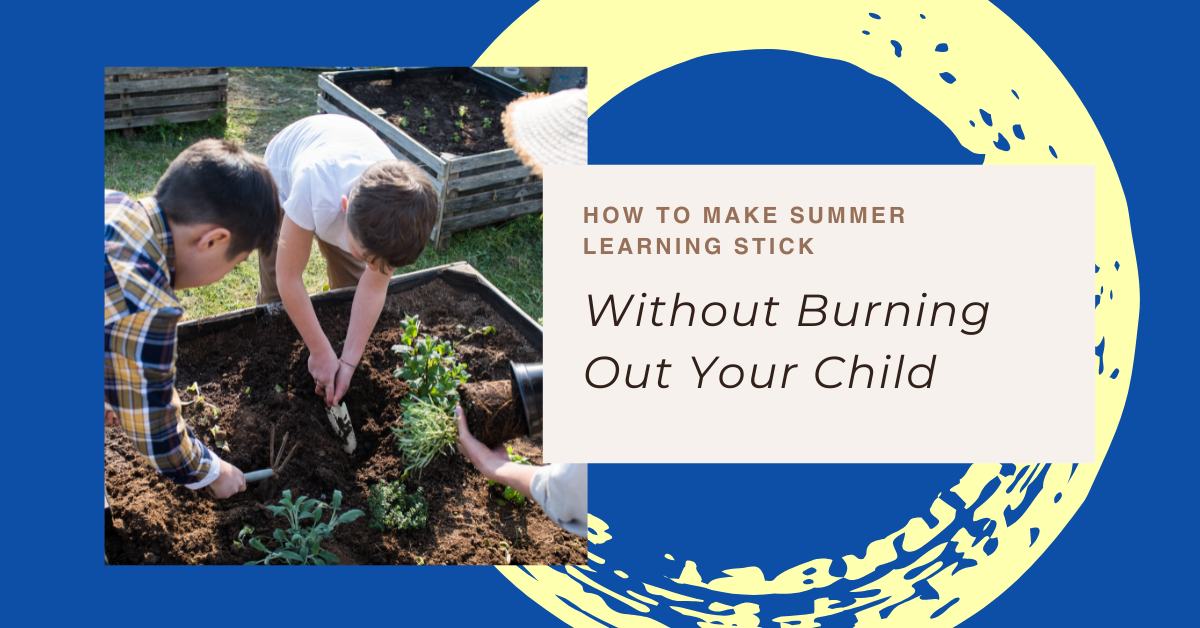
- Start a backyard or container garden: Give each child their own plant to care for. They research what it needs, water it on a schedule they create, and track its growth in a simple notebook. This teaches responsibility, patience, and basic science.
- Family book club: Let kids choose a book everyone reads together (or reads aloud over dinner). Talk about characters, choices, and what they would have done differently. This builds comprehension, perspective-taking, and confidence in sharing opinions.
- Write and mail real letters: Pen pals are making a quiet comeback, and for good reason. Writing a letter to a grandparent, cousin, or friend practices composition, empathy, and the satisfaction of a real-world response.
- Neighborhood jobs: A lemonade stand, a pet-sitting offer, or a car-washing service teaches math, planning, and what it actually feels like to work toward something.
- Map your neighborhood: Give kids a blank piece of paper and ask them to draw a map of your street or neighborhood from memory. Then walk it together. The conversation that happens along the way is the learning.
- Build something together: Birdhouses, cardboard cities, obstacle courses in the backyard. Building requires spatial reasoning, planning, and the ability to handle things not going as expected.
Social and emotional focus for this age: Handling disappointment, working through disagreements without adult intervention, learning to advocate for themselves, and building genuine friendships that require effort and compromise.
Summer Learning Activities for Kids: Grades 6 through 8
Middle school students are in one of the most identity-driven phases of development. They are figuring out who they are, what they care about, and where they belong. Summer gives them rare, low-stakes space to explore that without the social pressure of the school hallway hovering over every decision.
What the Research Says
Research published in Child Development (Yale School of Medicine) confirms that students who develop strong social-emotional skills show measurable improvements in academic performance, emotional well-being, and sense of belonging at school. Summer is when that internal development often accelerates, especially when teens have real experiences to reflect on.
Activities to Try
- Interview a family elder: Give your student a list of five questions and have them interview a grandparent, neighbor, or family friend. Recording it (on paper or audio) makes it feel meaningful. The conversations that happen are often ones families talk about for years.
- Volunteer for something they actually care about: Animal shelters, community gardens, library programs. Not because it looks good on a resume, but because doing something for someone else at this age rewires how they see themselves in the world.
- Start a how-to journal: Challenge them to learn one new skill per week and write or draw the process. Knitting, bread baking, basic home repair, learning a card trick. The subject matters far less than the habit of learning and reflecting.
- Plan and cook a family dinner once a week: From choosing the recipe to buying the ingredients to serving the meal, this is project management in disguise. It also shifts the family dynamic in small but real ways.
- Read something they would not normally choose: Biographies, true crime for younger teens, or a novel set in a different time period. Offer to read the same book so you can talk about it. The conversation matters more than the comprehension quiz.
Social and emotional focus for this age: Developing identity, building empathy through real-world exposure, learning to sit with discomfort, and beginning to understand that effort and persistence are choices they get to make.
Summer Learning Activities for Kids: Grades 9 through 12
High schoolers are close enough to adulthood that the most powerful summer learning often looks like actual adult experience. Not internships necessarily, though those are great, but real responsibilities, real relationships, and real reflection.
What the Research Says
A 2024 report from the Brookings Institution notes that summer experiences that connect academic skills to real-world contexts produce stronger retention than classroom-based review alone. For high schoolers especially, meaning and relevance are the conditions under which real learning happens.
Activities to Try
- Work a job, any job: The research on teen employment and social-emotional development is consistent. Students who work part-time during high school show stronger time management, communication, and resilience than those who do not. The job does not need to be prestigious. It needs to be real.
- Learn something completely outside their comfort zone: A pottery class, a basic auto mechanics workshop, a swimming or sailing lesson. Struggling at something new in a low-stakes environment builds humility and grit in ways that school rarely can.
- Keep a daily reflection journal: Not a diary, but a structured reflection. Three things: what happened, what they noticed about themselves, and one question it raised. Over a summer, this becomes an extraordinary document for college essays and self-awareness alike.
- Teach something to a younger person: A younger sibling, a neighbor, a child they babysit. Teaching requires understanding, patience, and the ability to communicate clearly. It also builds confidence in their own competence.
- Design and execute a personal project: Build something, launch something small, write something, plan a community event. The parameters are loose. The requirement is that they see it through from idea to completion.
Social and emotional focus for this age: Developing authentic confidence (not performance), learning to tolerate uncertainty, building the self-awareness that college and career demand, and beginning to understand who they are outside of a grade or a score.

Tips for Parents Across Every Age
Regardless of which age band your child is in, a few principles hold across all of them.
Protect unstructured time. The instinct to fill every hour is understandable, but boredom is genuinely productive. Children who have to figure out what to do next are building exactly the skills schools say they lack. Resist the urge to rescue them from it.
Let them fail at small things. The garden plant that does not make it. The lemonade stand that loses money. The recipe that needs a second attempt. These are not failures. They are the most efficient learning experiences available.
Talk about what they are experiencing. Ask open questions. Not “did you have fun?” but “what surprised you today?” or “what would you do differently?” The reflection is where the learning consolidates.
Do things alongside them, not just for them. The parent who plants in the garden, reads the same book, or sits at the same table while everyone works on something they care about creates a learning culture without making it feel like a program.
Let the summer be a little bit boring and a lot memorable. The summers that stick are rarely the ones that were perfectly planned. They are the ones where something unexpected happened, someone made something, or a conversation went longer than it was supposed to.
Summer Learning Activities for Kids Start With a Plan That Fits Your Family
Every child is different. What unlocks one kid shuts another one down. If you have been wondering whether your student is on the right path, not just academically but in terms of how they learn, where they are headed, and what kind of support would actually make a difference, that is exactly what BrightSpot Labs is here to help you figure out.
We work with families one-on-one to build real plans for real kids, whether that is navigating the college process, understanding a student’s learning profile, or simply helping parents feel less alone in the decisions they are trying to make.
Connect with BrightSpot Labs today and let us help you build a summer, and a plan, that actually fits your child.
Frequently Asked Questions
What are the best summer learning activities for kids without making it feel like school?
The best summer learning activities are the ones that do not feel like learning at all. Cooking, gardening, building things, playing strategy games, and exploring real interests all build genuine academic skills without replicating the classroom. Research consistently shows that children learn more when they have real choice and low-stakes stakes in what they are doing. The goal is engagement, not instruction.
How much do kids actually lose academically over summer without any learning activities?
Research from NWEA and Brookings consistently shows students can lose one to two months of academic progress over summer without any engagement. The loss is not uniform: reading tends to hold better than math, and lower-income students lose more than higher-income peers partly due to access gaps. Consistent engagement with books, problems, or any intellectually active activity prevents most of that slide.
What summer learning activities work best for elementary-age kids in grades 1 through 5?
Activities that involve real choices and real responsibility are most effective at this age. Cooking a recipe, managing a small garden, building a project, and self-selected reading all engage the problem-solving and self-management skills CASEL identifies as most predictive of academic success. The key is giving kids a real problem to work through rather than a task to complete for an adult.
How can parents encourage learning over summer for middle schoolers who resist anything that sounds like school?
Give middle schoolers a real problem to solve tied to something they actually care about, not a structured program that looks like summer homework. Research published in Child Development found that students who develop genuine self-awareness show better academic outcomes. A job, a creative project, a community commitment, or a skill pursued independently all outperform worksheets and programs for this age group.
Do kids need formal summer programs to avoid learning loss, or can parents support learning at home?
Both formal programs and home-based learning work, but parental involvement matters more than the format. Research consistently shows that students whose parents engage with what they are doing over summer learn more. That can be a structured program, or it can be a parent and child doing something meaningful together at home. The format is less important than the presence and genuine engagement of an adult.
Disclaimer: The information provided by BrightSpot Labs is for general informational and educational purposes only. Activity suggestions and research referenced in this post are intended to support family decision-making, not to replace individualized academic or developmental assessments. Every child develops differently, and what works for one student may not work for another. Families are encouraged to work with a qualified educational consultant or school counselor when making decisions about their child’s academic and social-emotional development. BrightSpot Labs is not responsible for outcomes resulting from strategies, advice, or information discussed in this content.