By Antonietta Breitenfeldt, M. Ed. | BrightSpot Labs
Having a child being bullied at school is one of the hardest situations a parent can face. You want to fix it immediately, but you also do not want to make things worse. You want your child to feel heard, but you also need to know what the school is actually required to do. The good news is that you have more options and more protections than most parents realize. This guide walks you through exactly what to do, what federal law says, and how to get the school to take action when a child being bullied at school needs protection.
Whether the behavior just started or has been building for months, knowing the right steps when a child being bullied at school comes home upset can make the difference between a situation that gets resolved and one that escalates into something much harder to fix.
In This Post
Bullying vs. Harassment: Why the Difference Matters
These words get used interchangeably, but legally they are not the same thing, and knowing the difference will affect how much pressure you can apply to the school.
Bullying is repeated, unwanted aggressive behavior that involves a real or perceived power imbalance. It can be physical, verbal, social (exclusion, rumor-spreading), or digital (cyberbullying). Every state has anti-bullying laws, but the specific definitions, school obligations, and consequences vary widely.
Harassment becomes a federal civil rights issue when it is directed at a student because of their race, color, national origin, sex, or disability. When that line is crossed, the school is not just dealing with a behavior problem. They are potentially violating federal law, and that changes everything about what you can demand from them.
Federal Protections for a Child Being Bullied at School
The single best starting point for any family is StopBullying.gov, the federal government’s central hub for bullying prevention and response. It covers definitions, warning signs, prevention strategies, and what schools are legally required to do. Bookmark it before you do anything else.
Beyond that hub, here are the specific federal protections that matter most depending on your situation:
Office for Civil Rights (OCR)
If your child is being targeted because of their race, color, national origin, sex, or disability, this is a civil rights violation, not just a school policy issue. The U.S. Department of Education’s Office for Civil Rights investigates complaints and holds schools accountable. You can file an OCR complaint directly if the school is unresponsive. This is one of the most powerful tools families have, and most parents never know it exists.
Title IX: Sex-Based Harassment
Title IX prohibits sex-based discrimination in any school receiving federal funding. That includes sexual harassment, gender-based bullying, and harassment targeting students because of their gender identity. Schools have a legal obligation to investigate and respond to Title IX complaints. If your child’s school is dismissing what sounds like sex-based harassment, ask specifically about their Title IX coordinator, because every school is required to have one.
IDEA and Section 504: Students with Disabilities
Students with disabilities have additional protections under both the Individuals with Disabilities Education Act (IDEA) and Section 504 of the Rehabilitation Act. If your child has an IEP or a 504 Plan and is being bullied because of their disability, the school is required to address it as part of their obligation to provide a free appropriate public education (FAPE). Bullying that interferes with a student’s ability to access their education is not just a behavior problem. It is a federal compliance issue.
Your First Steps When Your Child Tells You They Are Being Bullied
The first conversation matters a lot. How you respond in that moment will determine whether your child keeps talking to you about it or goes quiet.
Listen before you react. Your instinct may be to call the school immediately or tell your child exactly what to do. Resist that. Let them tell you the whole story first. Ask clarifying questions: How long has this been happening? Who else has seen it? Has anything changed recently? A child being bullied at school needs to know that you heard them before you acted.
Start a documentation log. Write down dates, times, locations, names, and exactly what happened. Keep copies of any text messages, screenshots, or emails. Make sure to do this when working through educators at your child’s school. If there are witnesses, note their names. This record is going to matter when you sit down with the school. A parent with a child being bullied at school who arrives at that meeting with written documentation is taken far more seriously than one who arrives with only a verbal account.
Make sure your child is safe first. A child being bullied at school who faces any immediate physical threat deserves that safety response first. Contact the school and local authorities right away. Documentation comes after safety.
Validate without catastrophizing. Your child needs to know you believe them and that this is not their fault. But they also need to see that you are calm and have a plan. Panic from a parent tends to increase anxiety in kids, not decrease it.
Track patterns over time. A single incident and a recurring pattern require very different responses. The more clearly you can document frequency, triggers, and who was involved, the stronger your case when you sit down with administrators. Parents dealing with a child being bullied at school often underestimate how much a well-organized paper trail shifts the conversation.
How to Work With the School Without Burning Bridges
Most schools want to resolve these situations. Start there. Do not assume bad faith before you have given them the chance to act.
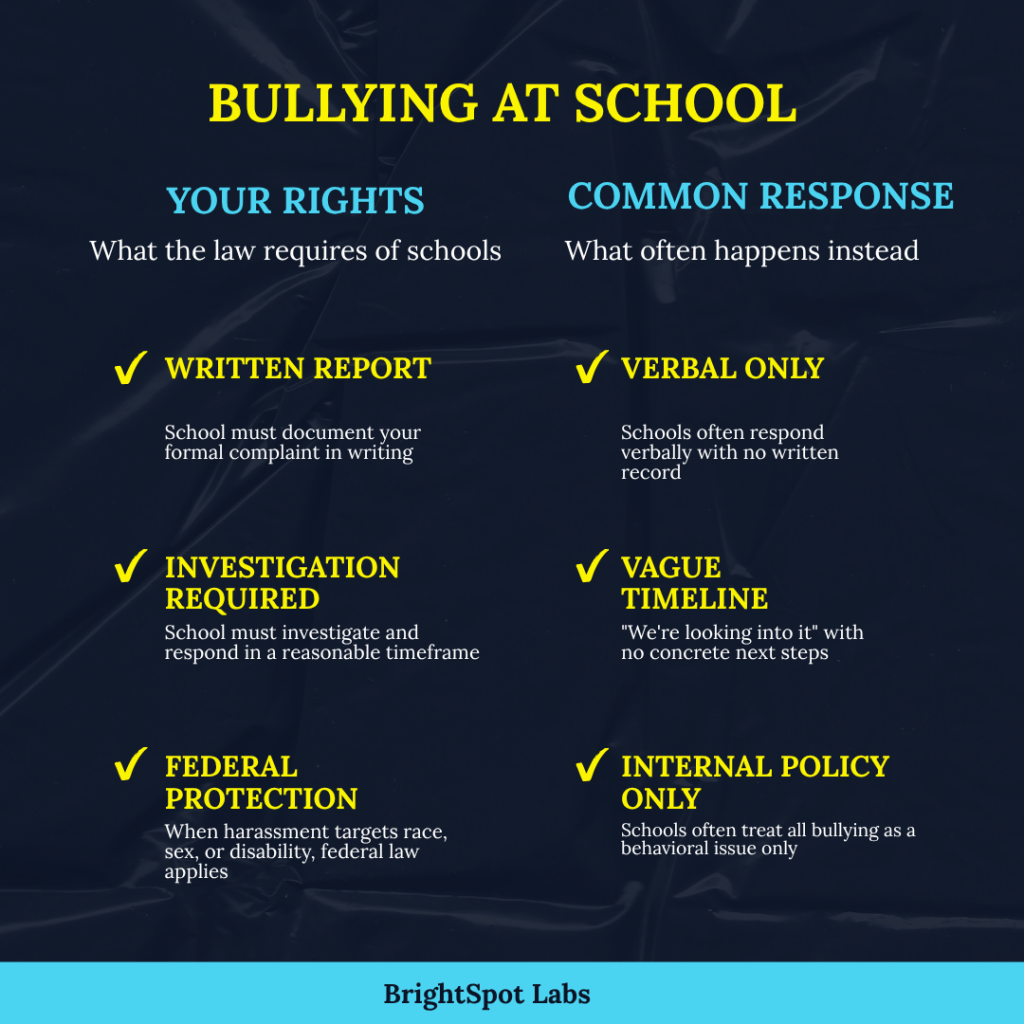
Request a meeting in writing. Send an email to the teacher, counselor, and principal. Our post on how to talk to your child’s teacher before a problem becomes a crisis can help you frame that first conversation. This creates a paper trail and signals that you are serious. State the facts clearly and without accusations.
Ask specifically what their bullying policy requires. Every school has an anti-bullying policy. Ask them to walk you through what steps are triggered by your report. If they cannot tell you, that is important information.
Follow up every conversation in writing. After any meeting or phone call, send a short email summarizing what was discussed and what the next steps are. This is not aggressive. It is responsible parenting.
Escalate methodically if nothing changes. School counselor, then principal, then district-level administrator, then your state’s Department of Education, then the federal OCR if harassment is civil rights related. Each step up the ladder gets more formal and carries more weight.
Real Parent Scenarios
My daughter is being excluded and mocked by a group of girls at school. The school says it is just drama. What do I do?
Social exclusion is a recognized form of bullying, and “it’s just drama” is not an acceptable response when it is persistent and targeted. Put your complaint in writing so there is a record. If it continues after you have reported it, request a formal meeting with the principal and reference the school’s anti-bullying policy. If the behavior is sex-based, mention Title IX. Sometimes schools move faster once they realize a parent knows their rights.
My son has an IEP and classmates mock him constantly about it. The teacher does not intervene.
This is a disability-based harassment situation with federal implications. Contact the special education coordinator at the school and put your concern in writing. Reference both IDEA and Section 504. If the harassment is affecting your son’s ability to participate in his educational program, it is interfering with his FAPE. Request an IEP meeting to address this formally and document everything.
My teen is being harassed online by classmates after school hours. The school says it is not their problem.
Most states’ anti-bullying laws now include cyberbullying, even when it happens off school grounds, if it creates a hostile environment at school. Check your state’s specific law at StopBullying.gov/resources/laws. Screenshot everything before it gets deleted. If the harassment involves threats or sexual content, contact law enforcement as well. The school may have more authority here than they are claiming.
Finding Your State’s Anti-Bullying Laws
Every state has anti-bullying legislation, but for any family with a child being bullied at school, the specifics matter enormously. How bullying is defined, what schools are required to investigate, what timelines apply, and whether cyberbullying is covered differ significantly from state to state. Rather than try to summarize all 50 here, we recommend going directly to StopBullying.gov/resources/laws. It maps out every state’s anti-bullying law in one place and is updated by the federal government, so the information stays current.
Your state’s Department of Education website is also a direct source for current policy. Search “[Your State] Department of Education bullying policy” and you will find the official guidance schools in your state are required to follow. If you are unsure what your child’s school is obligated to do, that is the document to read before your next meeting with administration.

What You Might Be Missing
The bystander problem. Research on bullying consistently shows that peer bystanders are present in the majority of incidents. If your child’s friends are watching and doing nothing, that is part of the culture problem. Talk to your child about what they can do as a bystander when they see someone else being targeted. This shifts some of the focus away from victimhood and toward agency. When a child being bullied at school sees their peers stand up for them, it can meaningfully change how they experience the situation.
Your child’s mental health needs attention now, not later. Even if the bullying stops tomorrow, kids who have been targeted often carry anxiety, hypervigilance, and trust issues that do not disappear on their own — and some of that anxiety can intensify at the start of each new school year, as we cover in our post on back to school anxiety and what parents can actually do about it. Do not wait for a crisis to connect them with a school counselor or outside therapist. Intervening early is almost always more effective than waiting to see how things shake out.
Retaliation is a real risk. If your child is a witness or has reported bullying on behalf of a peer, they can become a target themselves. Know the school’s anti-retaliation policy and watch for signs that the dynamic has shifted.
You can request records. Under FERPA, you have the right to access your child’s education records. If the school claims to have investigated and found nothing, you can request documentation of that investigation. Schools are often more thorough when they know a parent understands this.
Bullying can affect grades and attendance. A child being bullied at school often starts avoiding class, faking illness, or falling behind academically. If you are seeing a drop in grades alongside other warning signs, ask whether something social is happening first before assuming it is a learning issue. The two are connected more often than parents expect.
Your child needs a script, not just support. Most kids who are being bullied do not know what to say in the moment. Working with them on specific, calm, brief responses they can use, and practicing them at home, gives them a tool they can actually reach for when it counts. This is different from telling them to “stand up for themselves,” which puts an unfair burden on a child who is already overwhelmed.
How BrightSpot Labs Can Help
When a child being bullied at school is experiencing emotional fallout, it shows up everywhere, including in their academic confidence, their willingness to participate in class, and their ability to focus. At BrightSpot Labs, we work directly with students and families to help kids rebuild the confidence and executive function skills that get disrupted when school feels unsafe.
We also help parents navigate difficult school conversations. When a child being bullied at school has already experienced multiple incidents, knowing how to engage the school strategically makes a real difference. Sometimes you just need someone in your corner who understands how schools work, what questions to ask, and how to advocate effectively without escalating unnecessarily. If your family is dealing with a bullying situation and you are not sure what the next right move is, we are here to help you figure it out.
Frequently Asked Questions
What is the difference between bullying and harassment at school?
Bullying is repeated, unwanted aggressive behavior involving a real or perceived power imbalance. Harassment becomes a federal civil rights issue when a child is targeted because of their race, color, national origin, sex, or disability. Knowing the difference matters because harassment triggers federal protections that go beyond a school’s internal bullying policy, including the ability to file a complaint with the U.S. Department of Education’s Office for Civil Rights.
What should I do first when my child tells me they are being bullied?
Listen before you react. Let your child tell the full story without interrupting. Then start a written documentation log with dates, times, locations, names, and exactly what happened. Keep copies of any screenshots, texts, or emails. Contact the school in writing once you have a clear record of what occurred. Written communication creates accountability and a paper trail if you need to escalate later.
Can the school be held responsible if a child is bullied on school property?
Schools have a legal obligation to maintain a safe learning environment and must respond when bullying is reported. If the bullying rises to the level of harassment based on a protected characteristic, federal law requires schools receiving federal funding to investigate and take corrective action. Document everything and escalate methodically if the school fails to respond adequately.
What do I do if the school says the bullying is just drama and does nothing?
Put your complaint in writing so there is a formal record. Reference the school’s own anti-bullying policy and ask them to walk you through what steps are required under that policy. If the response is still inadequate, escalate to the principal, then the district administrator, then your state’s Department of Education, and if the behavior qualifies as civil rights harassment, file a complaint with the federal Office for Civil Rights.
Does the school have to address cyberbullying that happens off school grounds?
In most states, yes, if the cyberbullying creates a hostile environment at school. Most state anti-bullying laws now include cyberbullying even when it occurs off campus. Check your state’s specific law at StopBullying.gov or your state Department of Education website to understand what schools are required to investigate and what timelines apply.
Disclaimer: The information provided by BrightSpot Labs is for general informational and educational purposes only. This post is not a substitute for legal advice, licensed school counseling, or mental health services. If your child is in immediate danger, contact school authorities or law enforcement. BrightSpot Labs is not responsible for outcomes resulting from strategies, advice, or information discussed in this content.