By Antonietta Breitenfeldt, M. Ed. | BrightSpot Labs
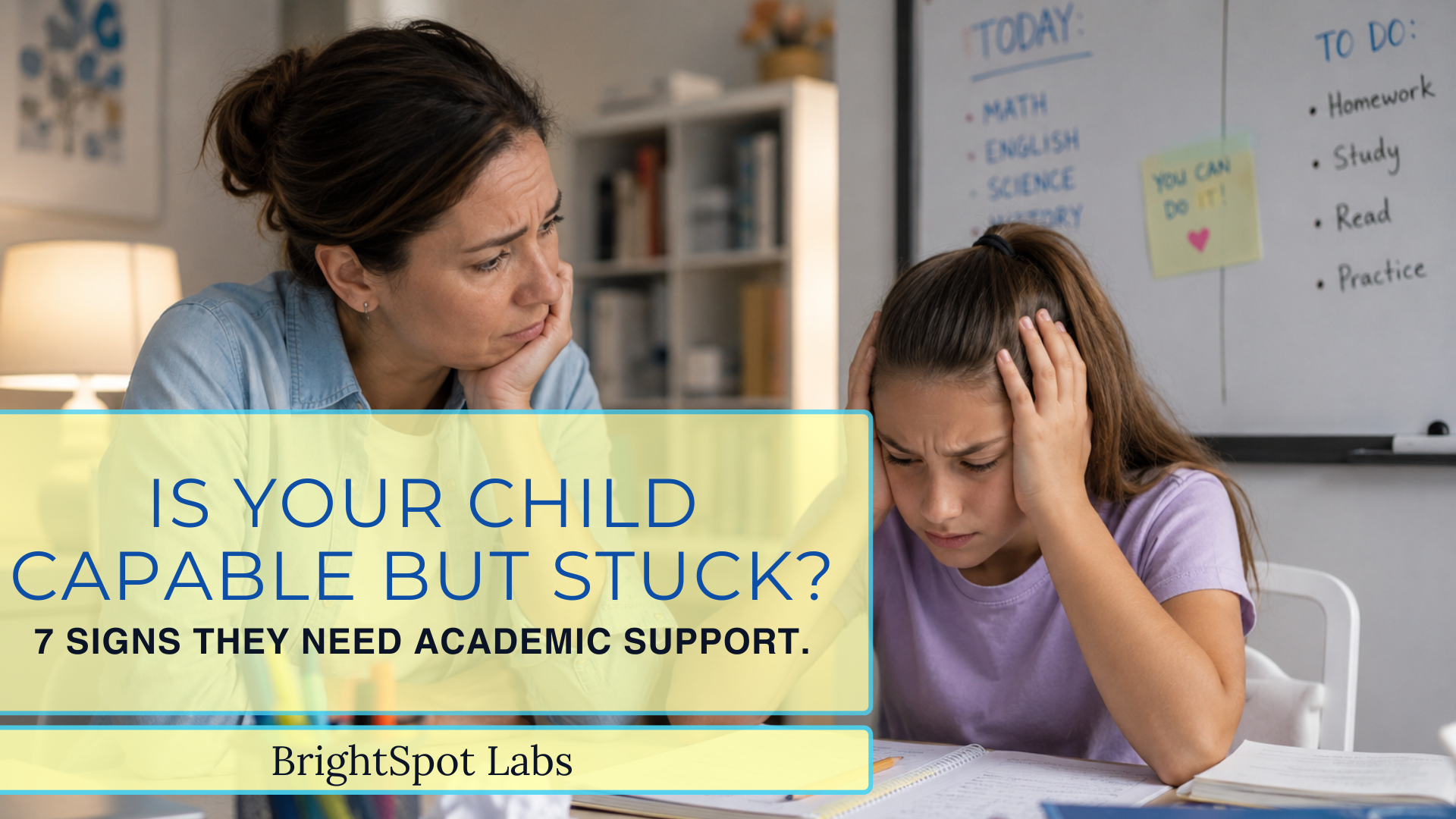
You know your child is smart. You have seen it. They explain complex ideas at the dinner table, they pick up new games in minutes, they ask the kind of questions that catch you off guard. And yet school is a constant struggle. Homework takes three hours and ends in tears. Grades do not reflect what they actually know. Teachers say things like “not working to their potential.” And your child, who you know is fully capable, is starting to believe maybe they are not.
This is one of the most frustrating positions a parent can be in, because the standard advice does not quite fit. “Try harder” does not apply to a child who is already trying. “Just sit down and do it” does not work when the block is deeper than motivation. What these children need is not more pressure. They need the right kind of academic support, and they need someone to recognize the signs before the gap between their potential and their performance becomes permanent.
This post covers what the research says about why capable kids get stuck, the specific signs to watch for, and what parents can do when they see them.
In This Post
Why Capable Kids Get Stuck
Academic underperformance in capable children is not a mystery, but it is misunderstood. The most common assumption is that a child who is not performing must not be trying. Research consistently points elsewhere.
The Child Mind Institute, a national nonprofit focused on child mental health and learning, notes that anxiety is one of the leading causes of academic underperformance in children who are otherwise intellectually capable. Anxiety does not look like worry in the classroom. It looks like avoidance, inconsistency, and shutting down under pressure. A child who freezes on tests but knows the material at home is not lazy. They are dysregulated.
Executive function is another major factor. Research from Understood, a national nonprofit supporting people with learning and attention differences, explains that executive function skills, including working memory, task initiation, organization, and flexible thinking, develop at different rates in different children. A student can be intellectually advanced and still have significant executive function gaps that make school feel overwhelming. That is not a character flaw. It is a developmental profile that responds well to the right kind of academic support.
Stanford psychologist Carol Dweck, whose research on mindset has been widely cited in educational settings, found that students who have been praised primarily for being “smart” rather than for effort are more likely to avoid challenges and disengage when work becomes difficult. They have been taught, unintentionally, that their identity depends on things coming easily. When things stop coming easily, they stop trying rather than risk looking like they are not smart after all. This pattern is especially common in capable students who sailed through early elementary school without much effort.
Learning differences, including dyslexia, ADHD, processing disorders, and twice-exceptionality (students who are both gifted and have a learning difference), often go unidentified in children who are managing to hold things together on the surface. According to the National Center for Learning Disabilities, approximately one in five people in the United States has a learning or attention difference. Many of these students are bright enough to compensate for years before the strategies stop working and performance drops.

7 Signs Your Child Needs Academic Support
These are the patterns worth paying attention to. One or two of them on a hard week is normal. A cluster of them over several weeks or months, especially in a child you know is capable, is a signal worth taking seriously.
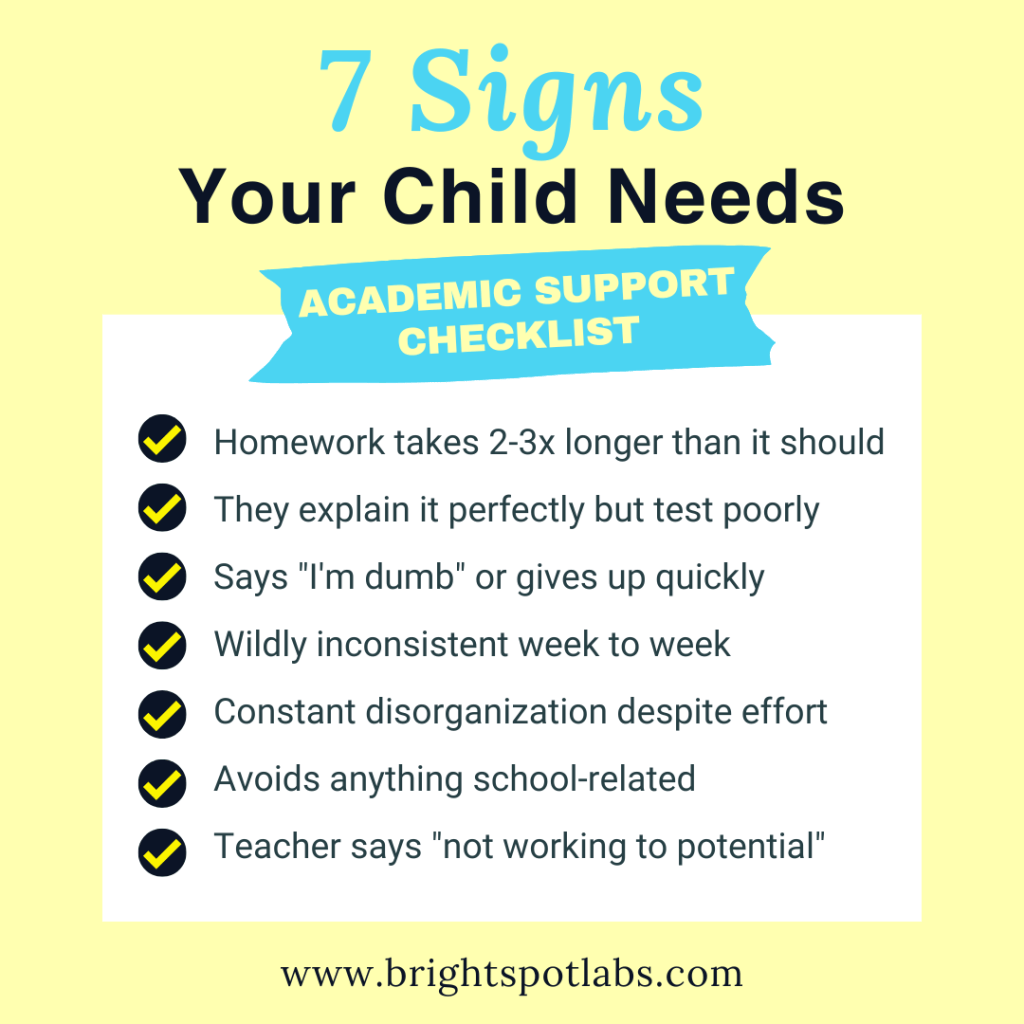
1. Homework Takes Far Longer Than It Should
Every child has slow homework nights. But if completing assignments consistently takes two to three times longer than teachers estimate, and the child is not dawdling but genuinely working the whole time, something is getting in the way. Processing speed differences, anxiety, difficulty initiating tasks, and unclear understanding of directions can all cause this. The child is not being dramatic. They are working harder than they should have to, and academic support can help identify exactly where the bottleneck is.
2. A Clear Gap Between How They Talk and How They Perform
This is one of the most telling signs. A child who can explain a concept clearly in conversation but cannot write a coherent paragraph about it, or who discusses history with nuance at the dinner table but fails the test on the same material, is showing you a performance gap, not a knowledge gap. The information is in there. Something is preventing it from coming out in the format school requires. That disconnect deserves investigation, not just more studying.
3. Phrases Like “I’m Dumb” or “I Give Up”
When a capable child starts narrating their own inadequacy, it is not just a bad attitude. It is information. Children who are struggling without understanding why will eventually reach an explanation that makes sense to them, and the most available one is “I must not be smart enough.” The American Psychological Association’s research on academic motivation shows that once a child adopts a fixed view of their own ability, disengagement follows quickly. Early academic support that helps the child understand what is actually happening for them can interrupt this cycle before it becomes entrenched.
4. Wildly Inconsistent Performance
Doing well one week and completely falling apart the next, with no obvious external cause, is a pattern worth paying attention to. Inconsistency often reflects something situational: how much sleep the child got, whether the assignment was presented in a format that works for them, how anxious they were that day, or whether a particular skill they struggle with was required.
Consistent underperformers are often easier to identify. Inconsistent performers are the ones who fall through the cracks because on the good days, everyone assumes the problem is solved. Academic support helps identify what is actually driving the inconsistency so the pattern can be addressed before it compounds.
5. Disorganization That Derails Everything
Missing assignments that were completed. Notebooks with no system. Forgetting to turn in work that is sitting in the backpack. Losing track of due dates despite writing them down. These are not signs of a careless child. They are signs of executive function challenges that academic support can directly address. Organization is a skill, not a personality trait, and it can be taught with the right strategies and the right support person.
6. Avoidance and Resistance Around Anything School-Related
Headaches on school mornings. Stomach aches before tests. Refusing to talk about school at all. Picking fights right when homework time starts. Avoidance this consistent is not manipulation. It is usually a sign that school has become associated with failure, frustration, or embarrassment. When a child’s brain has learned that school means feeling bad, it will do what brains do and try to avoid it. The answer is not to push through the avoidance harder. It is to figure out what the avoidance is protecting the child from.
7. Teacher Feedback That Points to Potential Without Traction
“She is so bright, but she just does not apply herself.” “He knows this material, I can tell, but he is not turning in work.” “She participates in class but her written work does not reflect what I hear from her.” If you are hearing some version of this at conferences, your child’s teacher is telling you there is a gap between capacity and output. That gap is exactly what academic support is designed to close. It is also a signal that the child needs more than a reminder to try harder.
What This Is Not
Before going further, it is worth naming what this pattern is not, because misidentifying it leads families in the wrong direction.
It is not laziness. Laziness implies the child could perform differently if they chose to. Most children who are capable and stuck are not choosing this. They are stuck in a cycle they do not fully understand and do not have the tools to break out of. That is exactly what thoughtful academic support provides.
It is not necessarily a learning disability. Some capable but stuck children do have undiagnosed learning differences. Others have anxiety, executive function gaps, or mismatches between their learning style and how they are being taught. A proper assessment can clarify which is which, but the academic support approach is often similar regardless.
It is also not something that will resolve on its own at the next grade level. The gap between capability and performance tends to widen as academic demands increase. Third grade covers for a lot. Middle school does not. High school covers for almost nothing.
What to Do When You See These Signs
The sequence matters here. Moving too fast or in the wrong direction wastes time and can make the child feel more broken than supported.
Start by Observing Without Reacting
Before taking any action, spend a week or two paying close attention to patterns. When does the struggle happen? Which subjects, which formats, which times of day? Is there a social component? A transition that preceded the drop? The more specific the picture, the more useful the next steps will be. A child who struggles specifically with writing assignments needs different academic support than one who falls apart on anything timed. The clearer your picture, the better matched your academic support will be.
Talk to the Teacher Before Drawing Conclusions
Teachers see the child in a context parents do not have access to. A good teacher conversation is not about asking whether your child is struggling. It is about asking what they notice, what has and has not worked in the classroom, and whether they have seen this pattern before.
Come prepared with specific observations rather than general concerns. “She spent two hours on the math homework last night and only got through four problems” is more useful than “she seems to be struggling with math.” For more guidance on making these conversations count, see our post on maximizing parent-teacher conferences as part of your academic support plan.
Rule Out Outside Factors First
Sleep deprivation, social stress, anxiety unrelated to school, and major life transitions can all produce academic performance drops in otherwise capable students. Before assuming the problem is academic, make sure the basics are covered. A child who is sleeping less than nine hours a night in elementary school or eight hours in middle school is operating under significant cognitive impairment, regardless of their underlying ability.
Consider a Formal Evaluation
If the pattern has been consistent for more than a few months, a psychoeducational evaluation can tell you a great deal about what is actually happening. Schools are required to evaluate students who may have learning differences, and parents can request this in writing at no cost. Private evaluations through a psychologist or neuropsychologist are also available and are often more comprehensive. An evaluation does not label a child. It gives everyone, including the child, language and strategies for what is actually going on.
Find the Right Kind of Academic Support
Not all academic support is the same. A content tutor who helps a child practice math facts is different from an academic coach who works on executive function, study strategies, and self-advocacy. At BrightSpot Labs, the Family Lab Collaborative is specifically designed for students and families navigating exactly this kind of challenge.
The right match depends on what the child actually needs, which is why observation and assessment come first. Bringing in academic support before understanding the problem often means solving the wrong problem very efficiently. For families who want to start somewhere practical while they explore more structured academic support, our guide to supporting learning at home is a useful first step.
The Conversation Most Parents Get Wrong
When parents see these signs, the instinct is often to have a direct conversation with the child about expectations, effort, and consequences. That conversation is not wrong, but the timing and framing matter enormously.
A child who is already convinced they are not smart enough does not need to hear that they are not trying hard enough. A child who is overwhelmed and avoidant does not need a longer list of things they are doing wrong. What they need first is for someone to make clear that the struggle makes sense, that it is not evidence of a permanent ceiling, and that there is a path forward that does not require them to be a different person.
The most effective conversations about academic support start with curiosity, not conclusions. “I have noticed homework has been really hard lately. Can you tell me what it feels like when you sit down to start?” opens a door. “You are not trying hard enough and you need to do better” closes it. The goal is to get the child talking, not defensive. Once they are talking, they will tell you exactly what they need.
BrightSpot Labs Works With Capable Kids Who Are Stuck
At BrightSpot Labs, we work with students who are clearly capable but not performing to their potential. We start by understanding the specific child, what is working, what is not, and what the gap between their ability and their output is actually about. Then we build a plan that addresses the real issue rather than just the symptom.
If you are watching your child struggle and you know there is more in there than what is showing up on paper, that instinct is worth trusting. Academic support looks different for every student. The right kind can change everything.
Connect with BrightSpot Labs today and let us help you figure out what your capable, stuck child needs.
If your child is heading into middle school and you are already seeing signs of struggle, our guide on the elementary to middle school transition walks through what is normal, what is not, and how to prepare before 6th grade begins.
Frequently Asked Questions
Why would a capable child struggle academically?
Capable children often get stuck due to unidentified learning differences, executive function gaps, anxiety, a fixed mindset about their own intelligence, or a mismatch between how they learn and how they are being taught. It is rarely about effort, and understanding the actual cause matters more than pushing harder.
What are the signs that a bright child needs academic support?
Key signs include homework consistently taking far longer than it should, a clear gap between how they communicate verbally and how they perform on paper, wildly inconsistent grades, avoidance of anything school-related, and teacher feedback that references potential without traction.
Is my child just being lazy, or is something else going on?
Most capable but stuck children are not choosing to underperform. Laziness implies a choice. Students who struggle without understanding why will often reach the conclusion that they are simply not smart, which creates a cycle that makes things progressively harder. The framing of laziness rarely helps and often makes it worse.
What type of academic support is best for a capable child who is underperforming?
It depends on the root cause. Content tutoring helps when there are specific knowledge gaps. Academic coaching addresses executive function, study strategies, and self-advocacy, which are the skills that often underlie underperformance in bright students. Identifying what is actually driving the struggle should come before choosing the type of support.
How do I talk to my child about needing academic help without making them feel worse?
Start with curiosity rather than consequences. Ask what homework actually feels like for them rather than why it is not getting done. A child who already feels like they are falling short does not need to hear that they are not trying hard enough. Opening the conversation that way shuts it down fast.
Disclaimer: The information provided by BrightSpot Labs is for general informational and educational purposes only. Academic struggles can have many causes, including medical, psychological, and neurological factors that require professional assessment and intervention. Nothing in this post constitutes a clinical diagnosis, therapeutic advice, or a substitute for evaluation by a licensed psychologist, neuropsychologist, or special education professional. If you have concerns about your child’s learning or development, consult with their school, a qualified educational specialist, or a licensed mental health professional. BrightSpot Labs is not responsible for outcomes resulting from strategies, advice, or information discussed in this content.