By Antonietta Breitenfeldt, M. Ed. | BrightSpot Labs
Senior year feels like a long runway until it does not. By the time school starts in August, the college application timeline is already in motion whether or not there is a plan in place. Students who enter senior year with a clear month-by-month schedule tend to submit stronger applications, make more intentional decisions, and arrive at May 1st with real choices instead of regrets.
According to Common App’s most recent annual report, the average applicant now submits to more schools than ever before, with many applying to ten or more colleges. That volume creates pressure. Without a college application timeline built around actual deadlines, that pressure turns into a scramble, and scrambled applications rarely represent what a student is fully capable of.
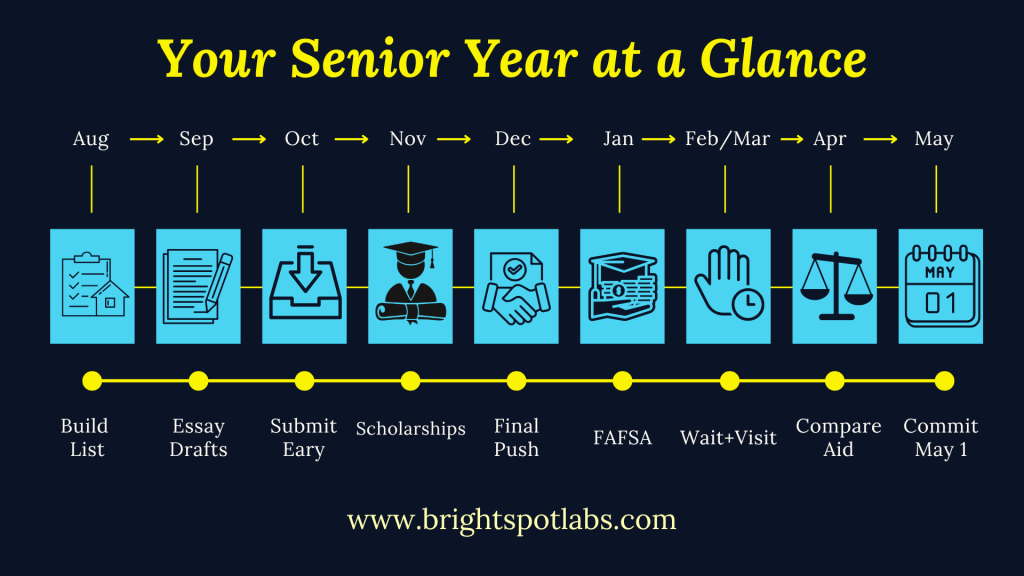
This post lays out the full senior year college application timeline, month by month, from August through May. Each section includes what students need to do and what parents should know, so both sides of the process are working from the same information at the right time.
In This Post
Why a College Application Timeline Matters
Timing is everything in the college process, and not because of artificial pressure. Real deadlines anchor the entire system. Early decision and early action applications typically close in late October or early November. Regular decision deadlines cluster in January. Financial aid forms, scholarship applications, and housing deposits all have their own windows that do not wait for the application process to slow down.
The National Association for College Admission Counseling (NACAC) consistently finds that students who begin the college application process in junior year and build deliberate timelines are better positioned to manage senior year demands without sacrificing academic performance. A college application timeline is not just a to-do list. It is a stress management tool.
The goal of this timeline is not to rush the process. It is to make sure nothing important gets missed, that early opportunities are used well, and that a student’s best thinking goes into applications rather than last-minute panic.
Early Decision vs. Early Action vs. Regular Decision
One of the most common points of confusion in the college application timeline is the difference between application types. Here is what each one actually means and who each one is right for before you sit down to build your senior year plan.
| Early Decision (ED) | Early Action (EA) | Regular Decision (RD) | |
|---|---|---|---|
| Binding? | Yes. If accepted, you must attend and withdraw all other applications. | No. You can apply to other schools and compare all offers before deciding. | No. You compare all offers and commit by May 1st. |
| Typical Deadline | November 1 or November 15 | November 1 or November 15 | January 1 or January 15 |
| Decision Arrives | Mid-December | December through February | Late March or early April |
| Best For | Students with a clear first-choice school who have completed the financial aid conversation and can commit without seeing other offers | Students who want an early answer but need flexibility to compare aid packages before deciding where to enroll | Students who want the full spring to compare options, negotiate aid, or are still finalizing their college list |
| Financial Aid | You receive one offer with limited room to negotiate. Know your budget before applying ED. | You can compare aid packages across all accepted schools before committing to any of them. | You receive all packages at once and can appeal or negotiate before the May 1st deadline. |
| Apply to Multiple Schools? | One school only | Most schools allow EA alongside other EA schools. Check each school’s specific policy. | No limit. Apply to as many schools as your college list includes. |
A note on school-specific deadlines: The dates throughout this timeline reflect the most common patterns in college admissions, but every school sets its own calendar. Some schools put their early decision deadline on November 1st, others use November 15th or December 1st. Supplemental essay prompts can change between cycles, and some schools add or drop supplemental requirements entirely. Always verify current deadlines directly through each school’s admissions page and the Common App portal, where school-specific requirements are refreshed each August before the application cycle opens.
August: Build the Foundation
The college application timeline officially starts before the first day of school. August is when students should finalize their college list, organize their application materials, and set up the systems that will carry them through the fall. Families who use this month intentionally gain a meaningful head start on students who wait until October to realize how much there is to do.
Student priorities for August:
- Finalize the college list, aiming for 8 to 12 schools across reach, match, and likely categories. If you are still building the list, this guide on how to build a college list that fits your family is a good place to start.
- Create accounts on Common App and any school-specific portals
- Request letters of recommendation from teachers and counselors early, with a clear deadline and a genuine thank-you
- Draft a resume of activities, awards, and relevant experiences for the Common App activities section
- Begin brainstorming Common App essay topics and write a rough first draft
For parents: August is the right time to run the net price calculator on every school on the list and to have an honest conversation about budget before applications open. Financial surprises in April are much easier to prevent in August. Families who set up a shared college application timeline document in August stay far better organized through the fall.
September: Essays and Final Testing
September is the month when the college application timeline gets real. Early action and early decision deadlines are six to ten weeks away, and the Common App essay is the linchpin of the entire application package. Students who do not have a working draft by mid-September are cutting it close, even for regular decision schools.
Student priorities for September:
- Complete and revise the Common App essay with feedback from a trusted adult who is not rewriting it for you
- Start or finish supplemental essays for early action and early decision schools
- Take the SAT or ACT if a stronger score is possible and there is still time before deadlines
- Confirm that recommenders have submitted or are on track to submit by your application deadlines
- Review your transcript for any errors and confirm course selections with your school counselor
For parents: Resist editing the essay into something that sounds like you. Admissions officers read thousands of applications each cycle and recognize when a teenager did not write their own essay. Your job is to support the process, not take it over.
October: Application Season Opens
October is the highest-stakes month in the college application timeline for most students. Early action and early decision deadlines fall on November 1st or November 15th at most schools. That means applications for those rounds need to be complete, reviewed, and submitted by the last week of October at the latest. Submitting on October 31st is not submitting early. It is submitting at the edge.
Student priorities for October:
- Submit early action and early decision applications by October 25th at the latest to allow time for technical issues
- Begin regular decision applications for all remaining schools on the list
- Confirm that all standardized test scores are sent to the correct schools before deadlines
- Follow up with recommenders to confirm submissions are complete in each application portal
- Review the Common App activities section for completeness and accuracy, it gets more scrutiny than most students expect
For parents: If your student is applying early decision to a school, that commitment is binding if accepted. Make sure both you and your student understand exactly what that means, and that the financial aid conversation has happened before the application goes in.
November: Early Results and Continued Work
Early decision results arrive in mid-December, and early action results often follow in December or January. November is the stretch between submitting early applications and hearing back, and it is one of the most underused months in the college application timeline. Students who use November well arrive at winter break with most of their regular decision applications close to finished.
Student priorities for November:
- Continue drafting and revising supplemental essays for regular decision schools
- Research scholarship opportunities available through each school and through external scholarship databases
- Check each application portal for missing materials and follow up immediately if anything is flagged as incomplete
- Attend any remaining virtual information sessions or college fairs still on the calendar
- Keep grades consistent, senior year transcripts matter more than most students realize
For parents: November is a good time to check in emotionally, not just logistically. The college process is stressful, and students who feel genuinely supported by their family rather than pressured report lower anxiety throughout the application period. A check-in that starts with “how are you doing with all of this” goes further than a check-in that starts with “have you finished your essays yet.”
December: The Final Push
December is when the college application timeline demands the most sustained focus. Early decision results arrive, which either closes part of the list or opens it back up. Regular decision deadlines are four to six weeks away. Winter break looks like free time but it is the most valuable working window most students will have before January 1st deadlines cluster together.
Student priorities for December:
- Submit any remaining early action applications if not already done
- Finalize all regular decision applications and plan to submit by December 28th at the latest
- If deferred from early decision or early action, write a strong letter of continued interest if the school welcomes them
- Identify any schools using rolling admissions and submit to those immediately
- Set up a tracking document for each application with expected response dates and financial aid deadlines
For parents: If your student receives an early decision acceptance, review the financial aid package carefully before anything else. A binding commitment is real, but families do have a formal window to negotiate if the package is significantly lower than expected. Understanding college financial aid before this moment happens makes the conversation much less stressful.
January: FAFSA and Financial Aid Season
January is financial aid month, and it is one of the most important points in the college application timeline for families. The FAFSA, the Free Application for Federal Student Aid, should ideally be completed as early as possible. Many states and schools have financial aid priority deadlines in January or February, and funds are not unlimited. Earlier submission typically means better access to available aid.
Student priorities for January:
- Confirm that all regular decision applications are submitted and complete
- File the FAFSA with a parent or guardian as early in January as possible
- Complete the CSS Profile if required by any schools on the list, typically private schools with more complex aid programs
- Check financial aid portals at each school for any additional required documents and respond within the requested window
- Research and apply to at least three to five external scholarships with January or February deadlines
For parents: FAFSA completion is a shared task. Both student and parent financial information are required, and the process takes roughly 30 to 45 minutes when tax documents are organized in advance. The Federal Student Aid office at studentaid.gov provides a step-by-step walkthrough. Do not put this off.
February and March: Waiting and Staying Active
February and March are the waiting months in the college application timeline, but they are not passive months. Regular decision results typically arrive in late March or early April. In the meantime, there is meaningful work to do that directly affects the quality of the decisions families will face in April.
Student priorities for February and March:
- Continue applying for scholarships at each school and through outside organizations, there is no deadline for this until you stop looking
- Track any outstanding financial aid documents and respond quickly if a school asks for more information
- Visit or revisit campuses for any schools still in serious consideration, admitted student days often happen in March and April
- Stay enrolled in challenging courses and keep grades consistent through the end of the year
- Prepare a real list of questions to ask when you visit admitted student programs
For parents: If you have not already compared schools using the net price calculator, now is the time to do that side-by-side work. Understanding the difference between grants, loans, and work-study before April takes the pressure off what can otherwise be a very short and emotionally charged decision window.
April: Decision Month
April is the most intense month in the entire college application timeline. Financial aid packages arrive, accepted students receive invitations to admitted student days, and families have to make real decisions with real money and a firm deadline. The national college decision day is May 1st, which means April is not a month to delay or postpone hard conversations.
Student priorities for April:
- Compare all acceptance letters and financial aid packages side by side using a consistent format
- Attend admitted student programs at top choices if possible, a campus visit at this stage can clarify a decision that felt impossible on paper
- Contact financial aid offices at top-choice schools if the package seems lower than expected, there is a formal appeals process and it is worth using
- Request additional time from a school only if waiting on a specific piece of financial information, not simply because you are undecided
- Make a final decision before May 1st with your family
For parents: April is the month for clear financial conversations. What the family can realistically contribute each year, what loan burden is manageable for the student after graduation, and what the student’s likely starting salary in their intended field might be are all numbers worth putting on paper together before May 1st. Understanding how college financial aid packages work before this moment makes the comparison much more manageable. And if a waitlist result or unexpected rejection comes in, this guide on helping your child through college rejection can help you navigate that conversation.
May: Commit and Close
May 1st is National College Decision Day, and it marks the official close of the college application timeline for most students. At this point, every item on the college application timeline has been completed, and the student heads into summer with clarity. After submitting an enrollment deposit to the chosen school, students need to withdraw from all others. The college process is not entirely over, but the decision is made, and that matters.
Student priorities for May:
- Submit the enrollment deposit to your chosen school by May 1st
- Notify all other schools of your decision and withdraw your applications promptly and politely
- Respond to housing applications, orientation registration, or placement exam requirements at your chosen school as quickly as possible, spots fill fast
- Send genuine thank-you notes to teachers and counselors who wrote recommendations on your behalf
- Finish senior year strong, final transcripts are sent to your enrolled school and can affect admission standing if grades drop significantly
For parents: This is a moment worth pausing for. The college application timeline is exhausting for everyone involved, and arriving at the end of it with a clear, confident decision is a real accomplishment. Take a moment to acknowledge that before moving on to the logistics of what comes next.

Mistakes That Derail the College Application Timeline
A few patterns come up repeatedly in families who end up in spring with fewer options than they expected, more debt than they planned for, or a student heading somewhere that was never really the right fit.
Starting too late. Students who submit the strongest applications have typically been working on essays since July. Starting the college application timeline in October means the essay gets whatever time is left over after homework, activities, and exhaustion. That is almost never enough time to produce work the student is proud of.
Building a list that is mostly reach schools. When results come in and every school was a long shot, families end up making high-stakes decisions without real options. A balanced college list with genuine match and likely schools protects everyone in the process.
Skipping financial aid research until April. Running the net price calculator and filing the FAFSA early is one of the highest-leverage actions a family can take. Waiting until decision month to understand cost turns a manageable comparison into a stressful emergency with almost no room to negotiate.
Missing external scholarship deadlines. Scholarships available through outside organizations operate on their own timelines, completely separate from the college application timeline at each school. Students who are not actively tracking both categories are leaving money behind.
What This Timeline Does Not Cover
This college application timeline reflects a traditional four-year university path using Common App with standard deadlines. Students who fall outside this framework should build a customized college application timeline with a counselor who knows their specific situation. It does not cover students applying to schools with unique portals or non-standard timelines, students pursuing performing arts, architecture, or design programs with portfolio or audition requirements that push preparation earlier, students exploring community college pathways or transfer applications, or students applying to military academies, which have entirely separate nomination and application processes.
If your student’s path does not fit neatly into this structure, the underlying principles still apply. Start earlier than feels necessary. Build in time for real revision. Run every financial decision through the net price calculator before committing to anything. And keep the student’s voice at the center of the process, because it is their education.
BrightSpot Labs Supports Seniors and Families Through the Entire Process
The college application timeline has a lot of moving parts, and it comes with real stakes for the whole family. At BrightSpot Labs, we work with seniors and their families from the moment the college list gets serious in August all the way through reviewing financial aid packages in April. Our support is specific, strategic, and built around the actual student in front of us, not a generic formula or a ranking chart.
Whether your family is heading into senior year and wants a clear plan from the start, or you are mid-process and realizing you need to reset, we can help you get organized and move forward with confidence at every step of the college application timeline.
Connect with BrightSpot Labs today and let us help you build a college application plan your whole family can feel confident about.
Frequently Asked Questions
When should a student start the college application process during senior year?
August is when the college application timeline should begin, before school even starts. Students who finalize their college list, request recommendation letters, and draft their Common App essay during the summer enter fall in a much stronger position. Waiting until October to start essays is one of the most common mistakes families make.
What is the difference between early decision and early action?
Early decision is binding. If a student is accepted, they must enroll and withdraw all other applications. Early action is non-binding, meaning students receive an answer before spring but can still compare financial aid offers from multiple schools before committing by May 1st. The right choice depends on how clear the student is about a first-choice school and whether the family has done the financial aid math ahead of time.
When should families file the FAFSA?
Families should file the FAFSA as early as possible, ideally in January or even late December. Many states and colleges have financial aid priority deadlines in January or February, and earlier filing gives families access to more available funds before they run out. The FAFSA requires both student and parent financial information, so gathering tax documents in advance makes the process much smoother.
Can students still apply for scholarships after submitting college applications?
Yes, and they should. External scholarships operate on completely separate timelines from each school’s application process. Students who stop searching for scholarships in December leave a significant amount of funding behind. Searching and applying through the entire spring semester, even after committing to a school, is time well spent.
What should a student do if they are deferred or waitlisted?
A deferral or waitlist placement is not a rejection. The best response is a letter of continued interest that communicates genuine enthusiasm and highlights any new academic achievements since the original application. Students should continue treating other acceptance options seriously, because waitlists move unpredictably and having strong backup plans is always the right call.
Disclaimer: The information provided by BrightSpot Labs is for general informational and educational purposes only. College application timelines, deadlines, and financial aid processes vary by institution and change from year to year. Nothing in this post constitutes financial aid advice, legal guidance, or a guarantee of admission outcomes. Families are encouraged to consult directly with their student’s school counselor, a certified college counselor, or a financial aid advisor for guidance tailored to their specific circumstances. BrightSpot Labs is not responsible for outcomes resulting from strategies, advice, or information discussed in this content.