
By Antonietta Breitenfeldt, M. Ed. | BrightSpot Labs
Every family going through the college process eventually asks the same question: what does it actually take? The college admissions process can feel opaque, especially when one student with strong grades gets waitlisted and another with what appears to be a thinner academic record gets in. Understanding what college admissions officers are genuinely looking for, rather than what families assume they want, is one of the most useful things a student can do before the application window opens.
The short answer is that college admissions is not a formula. It never has been. But it is also not a mystery. Admissions officers are trained evaluators reading thousands of applications each cycle, and they are looking for a consistent set of signals that tell them whether a student is ready, able, and genuinely interested in what their school offers. Those signals are learnable, and preparing for them makes a real difference.
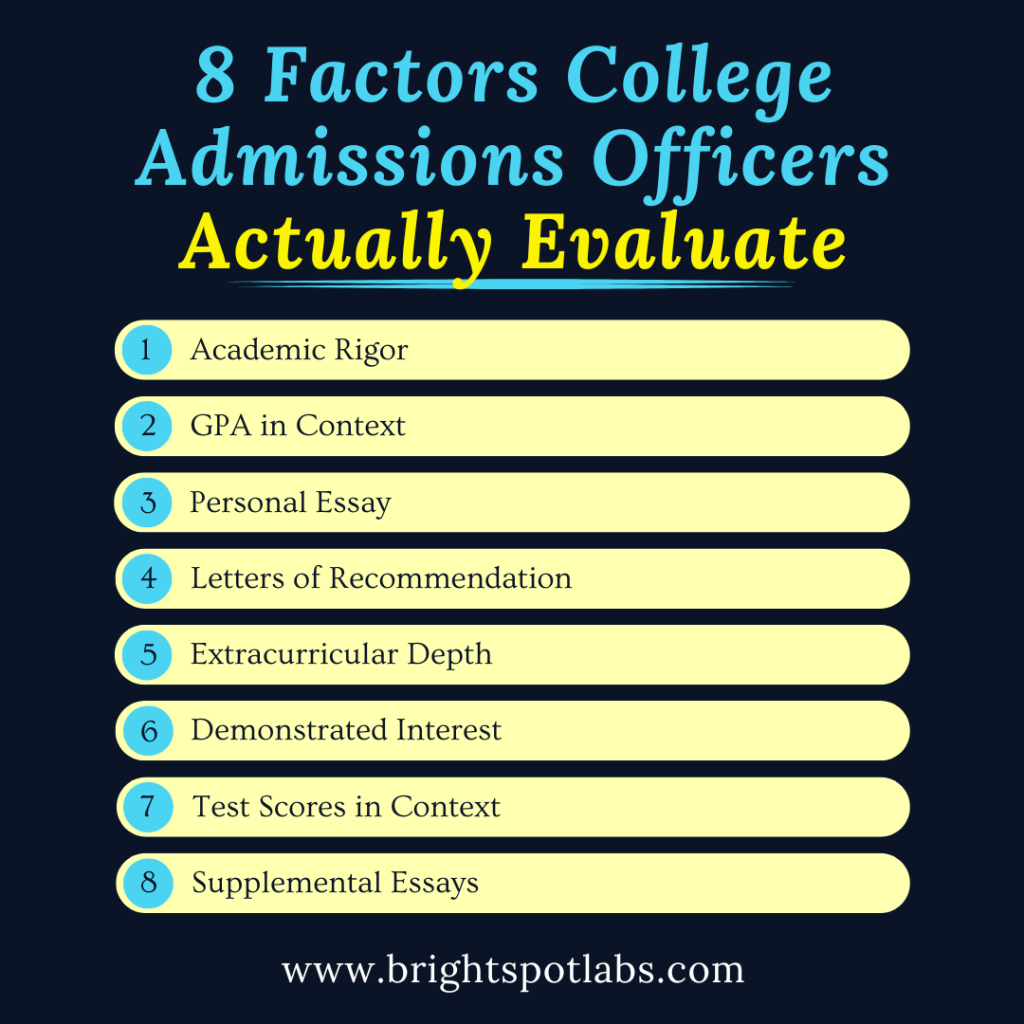
This post covers the eight factors that carry the most weight in college admissions decisions, what the research says about each one, and what students and families can do to make sure those factors are working in their favor before the application is submitted.
In This Post
How College Admissions Decisions Actually Get Made
Most selective colleges use a process called holistic review. That means no single factor determines the outcome. Admissions officers read each application as a complete picture, weighing academic preparation, personal qualities, extracurricular involvement, and a student’s potential contribution to their campus community all at once.
The National Association for College Admission Counseling (NACAC) Factors in the Admission Decision report ranks grades in college preparatory courses and strength of curriculum as the top two factors in admissions decisions, followed by overall grades and positive character attributes. Essays, recommendations, and demonstrated interest all factor in as well. Two things families often miss: admissions officers review each school’s high school profile alongside the transcript, which tells them what courses and opportunities were actually available to the student, so context matters in how a record is read. And while interviews are offered by fewer institutions, at the selective schools that do use them, they can influence the outcome, making preparation worthwhile for any student whose list includes those schools.
What holistic review means in practice is that a student with a 3.7 GPA who took the most rigorous courses available, wrote an honest and specific essay, and showed genuine interest in the school may be more competitive than a student with a 3.9 who coasted on easier coursework and submitted a generic application. Context is everything in college admissions.
A note on selectivity tiers: The weight each factor carries in college admissions varies significantly depending on the type of school. At highly selective institutions with acceptance rates under 20 percent, most applicants already have strong academics, so essays, recommendations, and demonstrated interest become more differentiating. At regional universities and schools with acceptance rates above 50 percent, a solid academic record and completed application often carry the most weight. Building a college list that includes schools across multiple selectivity tiers, and understanding what each school is actually evaluating, is one of the most practical things a family can do before applications open.

1. Academic Rigor: The Courses You Took Matter More Than the GPA Alone
When college admissions officers review a transcript, they are not just looking at the grade point average. They are looking at the level of courses behind it. A strong college admissions profile shows a student who challenged themselves with the most demanding curriculum their school offered, whether that means AP courses, IB coursework, dual enrollment, or honors-level classes in their areas of strength.
According to NACAC, grades in college preparatory courses are the single most important factor in admission decisions at four-year colleges and universities. A student who earns Bs in AP courses is often viewed more favorably than one who earns As in standard-level courses, because the rigor signals that the student can handle college-level work. Admissions officers read school profiles that tell them exactly what courses were available, so there is no hiding a light course load behind a high GPA.
What students and families can do: Review the course offerings at your high school and make sure the student is taking the most rigorous classes available in subjects where they have genuine ability. Do not overload to the point of academic collapse, but do not underload either. A balanced, demanding schedule sends the right signal to college admissions officers.
2. GPA in Context: Consistency and Trend Both Matter
GPA matters in college admissions, but it is always read in context. Admissions officers look at three things: the overall GPA, the rigor of the courses behind it, and the trend over time. A student whose grades improved steadily from sophomore to senior year tells a different story than one whose grades declined after a strong start. An upward trend is one of the most positive signals a transcript can send to college admissions readers.
Context also includes circumstances. A family illness, a significant life transition, or a school with limited advanced course offerings are factors that college admissions offices are trained to consider when they exist. The additional information section of the Common App gives students a place to provide that kind of context, and using it honestly can make a real difference in how a transcript is read. For students whose record reflects a longer pattern of academic struggle, understanding what is actually behind that struggle is worth addressing before the college admissions process begins.
What students and families can do: If there is a dip in grades with a real explanation behind it, use the additional information section to explain it briefly and factually. Do not dramatize. Do not over-explain. One clear paragraph is enough. And senior year grades matter to college admissions officers, so do not coast once applications are submitted.
3. The Personal Essay: Voice and Specificity Over Perfection
The personal essay is one of the few parts of the college admissions process entirely within a student’s control, and it is also the part most families misunderstand. College admissions officers are not looking for a polished piece of professional writing. They are looking for the student’s actual voice, a specific story, and something that helps them understand who this person is beyond grades and test scores.
The most common essay mistake is trying to write what the student thinks the admissions officer wants to hear. Essays about winning the championship game, overcoming adversity in broad strokes, or explaining why the student wants to “help people” are among the most frequently cited sources of fatigue in college admissions reading. What works is specificity: a real moment, a genuine observation, a detail that only this student could write.
Common App’s research consistently shows the essay is one of the few components that varies most between strong and weak applications. Students who start drafting in the summer before senior year and revise through multiple rounds of feedback produce significantly stronger essays than those who write them the week before the deadline.
What students and families can do: Start brainstorming essay topics in July or August. Write a rough draft that is far too long and then cut it down. Get feedback from someone who will tell you the truth. The essay should sound like the student talking at their best, not like a college admissions essay written to impress. BrightSpot Labs works with students on exactly this part of the process. Reach out to set up a call if you want an outside perspective before the essay is submitted.
4. Letters of Recommendation: Specificity Wins Every Time
Strong letters of recommendation in college admissions are not just positive. They are specific. A letter that says a student is “hard-working and a pleasure to have in class” tells the college admissions officer almost nothing. A letter that describes a specific moment when the student asked a question that reframed the class discussion, or pushed back respectfully on an idea in a way that showed real intellectual engagement, tells them something they cannot get anywhere else in the application.
The best recommenders are teachers who have seen the student do real intellectual work, not just earn good grades. A teacher who taught the student in a class where they struggled and grew can be a more compelling recommender than one from a class where everything came easily. Counselor recommendations matter too, and students who have had genuine conversations with their school counselor about their goals give that counselor something meaningful to write.
What students and families can do: Ask recommenders early, in spring of junior year if possible, and give them a brief document with a few specific anecdotes, the student’s goals, and the schools being applied to. This gives recommenders the raw material to write something specific rather than generic, which is what college admissions officers are looking for.
5. Extracurricular Activities: Depth Over Breadth
One of the most persistent myths in college admissions is that a long list of activities is better than a short one. It is not. College admissions officers read activity lists looking for commitment, growth, and leadership over time, not volume. A student who has spent four years seriously involved in one or two things and taken on increasing responsibility tells a far more compelling story than one who joined twelve clubs in senior year to pad the list.
The Common App activities section allows ten entries, and most strong applicants do not fill all ten. What matters is that the activities listed show something real about who the student is and what they care about. A summer job, a family caregiving responsibility, or a self-directed creative project can be just as compelling to college admissions readers as any organized school activity, and often more so.
What students and families can do: Identify the two or three activities that represent genuine investment and write the descriptions to show what the student actually did, not just their title. “Captain, varsity soccer” is less informative than “Led team practices three times weekly; organized community service project that raised $2,000 for local youth program.” College admissions officers read the difference immediately.
6. Demonstrated Interest: Showing the School You Actually Want to Be There
Demonstrated interest is one of the most underrated factors in college admissions, particularly at schools that actively track it. Many colleges monitor whether applicants have visited campus, attended information sessions, connected with admissions representatives at college fairs, or engaged with their outreach. This data feeds directly into yield calculations, which affect how schools manage their admission offers.
NACAC data consistently shows that demonstrated interest ranks as an important or very important factor at a significant share of four-year colleges. At schools that track it, a student who has made no contact with the college admissions office may be at a disadvantage relative to an otherwise similar applicant who attended a virtual info session, visited campus, and emailed an admissions representative with a thoughtful and specific question.
What students and families can do: For each school on the college list, identify one or two concrete ways to demonstrate genuine interest before submitting. Visit if possible. Attend a virtual info session. Email an admissions representative with a specific question about a program that matters to the student. These actions cost very little time and signal something college admissions offices pay attention to.
7. Standardized Test Scores: Context Has Changed, But Scores Still Matter
The test-optional movement changed the landscape of college admissions significantly, and policies continue to evolve. Many selective schools made test-optional permanent, while others returned to requiring scores or moved to test-flexible approaches. The important thing for families to understand is that test-optional does not mean test-irrelevant. At most schools, students who submit strong scores are still at an advantage in college admissions review.
Research from Opportunity Insights (Chetty, Friedman, and Deming, 2023) found that SAT and ACT scores remain among the strongest predictors of students’ post-college outcomes, particularly at highly selective institutions. Students who have strong scores should submit them. Students who do not should research each school’s current policy carefully and understand how their academic record looks without that data point in the college admissions file.
What students and families can do: Take standardized testing seriously enough to prepare, and take it more than once if the first score does not reflect the student’s ability. Research the middle 50% score range for every school on the list using each school’s Common Data Set or the NCES College Navigator before deciding whether to submit scores in the college admissions process.
8. Supplemental Essays: The “Why Us” Question Is Not Optional
Most selective colleges require supplemental essays beyond the Common App personal statement, and the most common of these is some version of “why do you want to attend our school?” This is where a large share of applicants lose ground in college admissions, because they answer it generically. Naming a school’s reputation, its beautiful campus, or a vague commitment to academic excellence tells the admissions officer that the student has not done their homework.
A strong “why us” essay names specific programs, specific faculty, specific courses, or specific student organizations that are unique to that institution. It shows the student has researched the school seriously and can articulate exactly how it fits what they are looking for. This kind of specificity is one of the clearest signals of genuine interest and genuine fit that a college admissions officer can read in any application.
What students and families can do: For every school that requires a supplemental essay, spend at least 30 minutes researching beyond the homepage. Look at department pages, course catalogs, student research opportunities, and student organizations. Find two or three things that genuinely connect to the student’s interests and write the essay around those specific details. Generic “why us” essays are one of the most common reasons otherwise strong college admissions candidates are passed over at their target schools.
What College Admissions Officers Say About Common Mistakes
Beyond what works, college admissions officers are consistent about what does not. These patterns surface repeatedly in admissions reading, and each one is avoidable.
The resume essay. An essay that reads like a summary of the activities section adds nothing. College admissions officers have already read the activities list. The essay is the place to go deeper, not wider.
The wrong school name in a supplemental. Submitting a “why us” essay with the wrong school’s name is more common than most families realize, and it signals to college admissions readers that this application was copied and pasted. Every supplemental must be proofread for this before submission.
Accomplishments without a person behind them. College admissions officers can tell when an application has been assembled strategically rather than honestly. The students who stand out are the ones whose application feels like a coherent whole, where the essay, activities, and recommendations all tell the same story from different angles.
Waiting until senior year to start building the application. The strongest college admissions candidates start the process in sophomore or junior year, not because they are rushing, but because the activities, relationships with teachers, and self-knowledge that make a strong application take time to develop. A clear college application timeline built in advance makes an enormous difference.
What a Strong College Admissions Application Actually Looks Like
A strong college admissions application does not have to be perfect. It has to be coherent, specific, and honest. The academic record shows a student who took their education seriously. The essay sounds like a real person who has thought carefully about who they are. The activities reflect genuine commitment to something that matters to them. The recommendations come from people who actually know the student well. And the school-specific materials show the student has done the work of understanding what that college offers and why it fits.
Students who build that kind of application, rather than chasing a version of themselves they think college admissions officers want to see, consistently produce stronger results. The college admissions process rewards authenticity more than it rewards perfection, and that is genuinely good news for families willing to do the real work of preparing.
Frequently Asked Questions About College Admissions
What do college admissions officers actually look for first?
Most admissions officers begin by reviewing academic performance, specifically the rigor and consistency of a student’s coursework over four years. They want to see that a student challenged themselves appropriately for their school’s offerings, whether that means AP courses, dual enrollment, or the most demanding courses available. GPA matters, but context matters just as much. A 3.7 from a student who took the hardest schedule available tells a different story than a 3.9 from someone who avoided challenge. After academics, officers look at how a student has spent their time outside the classroom and what kind of person comes through in the application overall.
How important is the college essay compared to grades and test scores?
At highly selective schools, the essay often becomes the deciding factor between two academically similar applicants. Grades and test scores establish a threshold, but the essay is where a student’s actual voice, perspective, and self-awareness come through. Admissions officers read thousands of essays describing sports injuries and mission trips. What stands out is specificity, honesty, and a sense of genuine reflection. A student who can write compellingly about a small, meaningful experience will almost always outperform one who writes broadly about a major accomplishment.
Does demonstrated interest really affect admissions decisions?
At many schools, yes. Demonstrated interest, which includes campus visits, attending virtual information sessions, opening emails, and writing a specific and knowledgeable Why This College essay, signals to admissions offices that a student is likely to enroll if accepted. Schools track yield rate carefully, and a student who has clearly done their homework about a school is seen as a lower risk of declining an offer. At some institutions, demonstrated interest is explicitly weighted in the admissions formula. It is worth checking each school’s Common Data Set (Section C) to see whether the school reports it as important.
What is the most common mistake students make in their college applications?
Writing for an imagined audience rather than being genuine. Many students try to guess what an admissions officer wants to hear and end up sounding like everyone else. The second most common mistake is underusing the additional information section. If there is context that explains a dip in grades, a gap in activities, or a circumstance that shaped who a student is, that section exists for exactly that purpose. Leaving it blank when it would be genuinely helpful is a missed opportunity. A close third is treating the Why This College essay as generic. Officers can tell immediately when a student has swapped one school’s name into a template.
How do holistic admissions work at selective colleges?
Holistic admissions means the application is reviewed as a whole rather than through a single metric. Officers are building a class, not just selecting individuals, so they are thinking about which students bring something distinct to the community. A student might be academically strong but blend in with a hundred similar applicants. Another might have a lower GPA but a remarkable background, a skill the school is recruiting for, or a story that shifts how the class looks as a whole. This is why no application should be evaluated in isolation, and why students benefit from understanding how their full profile reads together rather than optimizing any single element.
As you research schools, keep in mind that the college rankings you encounter during this process tell only part of the story. Our guide on how to use college rankings without getting misled breaks down what the major lists actually measure, which metrics get gamed, and the five questions every family should ask before any ranking shapes their college list.
BrightSpot Labs Helps Students Build Applications That Reflect Who They Actually Are
At BrightSpot Labs, we work with students and families throughout the college admissions process, from building a strategic college list in junior year to reviewing applications and essays before they are submitted. Our approach starts with the student in front of us, not a template. We help families understand what college admissions officers are actually looking for at each school on their list, and we help students build applications that tell a clear, honest, and compelling story.
If your student is preparing for the college admissions process and you want a plan specific to their profile, we can help you figure out exactly where to focus and what to do next.
Connect with BrightSpot Labs today and let us help your student build a college application that gives them a real shot at the schools that are right for them.
Disclaimer: The information provided by BrightSpot Labs is for general informational and educational purposes only. College admissions policies, requirements, and processes vary significantly by institution and change from year to year. Nothing in this post constitutes a guarantee of admission outcomes or a substitute for guidance from your student’s school counselor or a qualified college planning professional. BrightSpot Labs is not responsible for outcomes resulting from strategies, advice, or information discussed in this content.