Every August, millions of families face the same question: is my child actually ready for kindergarten? It feels like a big decision, and honestly, it is. But kindergarten readiness is not about whether your child can write their name perfectly or count to 100. It is about so much more than that, and most parents do not get a clear picture of what readiness really looks like until they are deep in it.
This guide breaks down what kindergarten readiness actually means, the skills that matter most across five key areas of development, and concrete steps you can take this summer to help your child walk into that classroom feeling confident and capable. The research here comes from developmental pediatricians, early childhood education experts, and national organizations who study how young children learn and grow.
Whether your child is already showing signs of readiness or you have some concerns, you will find practical, research-backed guidance here. Kindergarten readiness is not a pass-fail test. It is a starting point.
In This Guide
What Kindergarten Readiness Actually Means
The American Academy of Pediatrics defines kindergarten readiness as a child’s ability to function effectively in a structured school environment, and the AAP is clear that readiness spans social, emotional, physical, and cognitive domains, not just academics. In a widely cited policy statement, the AAP emphasized that play is the primary vehicle through which young children develop the competencies they need for school success.
The National Institute for Early Education Research (NIEER) has studied kindergarten readiness for decades and consistently finds that children who enter kindergarten with strong social-emotional skills, curiosity, and basic communication abilities are better positioned for long-term academic success than children who have been drilled on letters and numbers in isolation. According to NIEER, the quality of a child’s preschool experience is one of the strongest predictors of kindergarten readiness, with high-quality programs producing measurable gains in language, literacy, and math.
Zero to Three, a nonprofit focused on early childhood development, describes kindergarten readiness as a two-way street: children need to be ready for school, and schools need to be ready for children. This framing is worth holding onto because it takes some of the pressure off families. Your child does not need to arrive at kindergarten as a finished product. Zero to Three’s research shows that most kindergarten teachers rank curiosity, communication, and the ability to follow simple directions as the top readiness indicators, ranking them above reading or writing skills.
The 5 Areas of Kindergarten Readiness That Matter Most
Kindergarten readiness experts consistently point to five developmental domains when assessing whether a child is prepared for the kindergarten classroom. No single area tells the whole story, and children develop unevenly, which is completely normal. Think of these as five lenses, not five boxes your child has to check.
1. Social and Emotional Development
This is the area that kindergarten teachers say matters most, and it is the one parents tend to underestimate. Social and emotional readiness means your child can separate from you without extended distress, take turns and share materials with peers, express basic emotions with words rather than meltdowns, follow classroom rules and transitions, and begin to resolve minor conflicts with some adult guidance. The Child Mind Institute notes that children who struggle socially in kindergarten often have a harder time academically, not because of intelligence, but because learning in a group setting requires social bandwidth. Building these skills before the first day of school pays dividends across every other domain of kindergarten readiness.
2. Language and Communication Skills
Language is the engine of learning. Strong kindergarten readiness in this area means a child can speak in complete sentences, listen to a story and answer simple questions about it, follow two- or three-step directions, understand and use basic vocabulary across familiar topics, and communicate needs and feelings clearly to adults and peers. Pre-literacy skills like recognizing their own name in print, understanding that text is read left to right, and identifying rhyming words are also part of this picture. According to NIEER research on language development, children who are read to regularly from infancy enter kindergarten with vocabularies that are significantly larger than those who were not, and vocabulary size at kindergarten entry is a strong predictor of third-grade reading achievement.
3. Cognitive and Academic Foundations
Cognitive readiness for kindergarten is less about knowing specific facts and more about how a child approaches problems and new information. A ready child is curious. They can sort objects by color, shape, or size. They can count a small set of objects, recognize some letters, especially those in their name, and understand basic concepts like big and small, before and after, more and less. They can also sustain attention on a task for about 10 to 15 minutes with appropriate adult support. What kindergarten teachers actually want is a child who is willing to try, willing to ask for help, and willing to engage with new ideas. Kindergarten readiness in the cognitive domain is as much about disposition as it is about content knowledge.
4. Physical Development
Physical development for kindergarten readiness covers two areas: gross motor and fine motor skills. Gross motor readiness means a child can run, jump, climb, and balance without significant difficulty, which matters for recess and PE but also for a child’s overall sense of confidence in their body. Fine motor readiness is arguably more critical to daily classroom life. Children need enough hand strength and coordination to hold a pencil or crayon, use scissors, manipulate small objects like blocks or puzzle pieces, and manage fasteners on clothing like buttons and zippers. Fine motor skills are directly linked to early writing development, and children who struggle in this area often need additional support during handwriting activities in kindergarten. The American Academy of Pediatrics recommends that parents provide plenty of hands-on play experiences before kindergarten specifically to support fine motor development.
5. Self-Care and Independence
Kindergarten teachers often say this is the area they wish more parents focused on. Self-care readiness means a child can use the bathroom independently, wash their hands, manage their lunch box and backpack, put on and take off their own shoes and jacket, and communicate when they feel sick or need help. These skills sound basic, but when a classroom has 20 or more children, a teacher cannot tie 20 pairs of shoes or walk 20 children to the bathroom individually. Children who can manage their own basic needs are more available for learning. Kindergarten readiness in the self-care domain is also a confidence issue: children who can take care of themselves physically tend to feel more capable in the classroom overall.
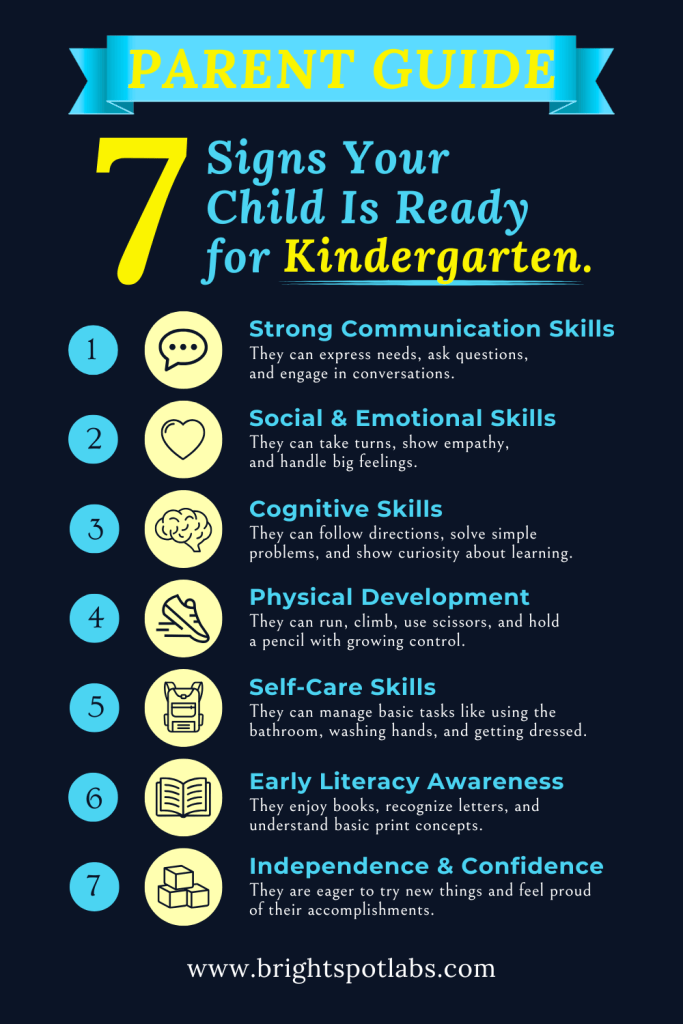
Signs Your Child Is Ready for Kindergarten
Here are ten concrete signs that your child is showing strong kindergarten readiness across the five domains described above. No child will show all ten perfectly, and that is fine. This list is meant to give you a practical snapshot, not a report card.
- They can separate from you at drop-off without extreme distress most of the time.
- They play alongside or with other children and are beginning to take turns.
- They speak in complete sentences and can tell you about something that happened to them.
- They can follow a two- or three-step direction without needing it repeated multiple times.
- They recognize their own name in print and show interest in letters or books.
- They can count a small set of objects and understand concepts like more and less.
- They can hold a pencil or crayon and draw simple shapes or lines with intention.
- They can use the bathroom independently and manage basic personal hygiene.
- They show curiosity about the world and ask questions about what they see and experience.
- They can sit and attend to a story or activity for 10 to 15 minutes with support.
What to Do If Your Child Is Not Quite Ready
First, breathe. Not being fully ready for kindergarten at the start of PreK year, or even in the spring before kindergarten, does not mean something is wrong with your child. Development is not linear, and kindergarten readiness looks different in every child. What matters is what you do with the information you have.
Talk to your child’s current preschool teacher. They observe your child daily and can give you a grounded, realistic picture of where your child stands across all five readiness domains. If there are specific concerns about language, behavior, or development, ask the teacher whether they recommend a conversation with your pediatrician or a referral to your local school district for a developmental screening. In the United States, public school districts are required to provide free developmental evaluations for children ages three and older, and identifying a need early gives you more time to get support in place before kindergarten begins.
Some families consider delaying kindergarten entry by a year, a practice sometimes called academic redshirting. The research on redshirting is genuinely mixed. A study published in JAMA Pediatrics found that children who were held back a year showed fewer signs of inattention and hyperactivity at age 11, but other research shows that the academic advantages of redshirting tend to fade by third grade. The decision to delay is deeply personal and should be made in consultation with your child’s teachers, pediatrician, and any specialists involved in your child’s care, not based on comparisons to other children.
If kindergarten readiness concerns are related to social-emotional skills specifically, targeted support like social skills groups, play therapy, or increased structured play experiences can make a meaningful difference in a relatively short period of time. The Child Mind Institute has excellent resources for families navigating social-emotional development concerns in early childhood. If academic support needs emerge once kindergarten begins, our guide on recognizing when a child needs academic support can help you identify the signs and figure out next steps.
One practical detail that often gets overlooked during readiness conversations: kindergarten entry cut-off dates vary significantly by state and sometimes by district. Most states require a child to turn five by September 1, but cut-offs range from July 31 to December 1 depending on where you live. Readiness decisions and eligibility decisions are related but separate conversations. Before making any decisions about timing, confirm your school district’s specific enrollment requirements so you have accurate, complete information.
How to Support Kindergarten Readiness Over the Summer
The summer before kindergarten is one of the most valuable windows parents have to build readiness in a low-pressure, play-based way. You do not need a structured curriculum or a workbook. What you need is intentional, consistent practice woven into everyday life. Here are six areas to focus on.

Read Together Every Day
Daily read-alouds are the single highest-leverage thing you can do for your child’s kindergarten readiness this summer. Reading together builds vocabulary, comprehension, listening skills, and print awareness all at once. Choose books slightly above your child’s independent reading level to stretch their language. After reading, ask open-ended questions: what do you think will happen next, why did that character do that, how would you feel if that happened to you? These conversations build the kind of inferential thinking that kindergarten teachers look for during read-aloud time. For more on making summer reading feel natural and low-pressure, see our guide on summer reading strategies that actually work for K-8 kids.
Practice Fine Motor Skills Through Play
You do not need pencils and worksheets to build fine motor skills. Play dough strengthens hand muscles. Tearing and cutting with child scissors builds control. Threading beads, using tongs to transfer small objects, drawing in sand, painting, building with small blocks, and even peeling stickers all develop the hand strength and coordination that kindergarten readiness requires for writing and classroom tasks. Aim for at least 15 to 20 minutes of fine motor play daily over the summer.
Build Routines and Practice Independence
Kindergarten operates on a predictable daily schedule, and children who have experience with routines adjust significantly faster. Over the summer, establish a consistent morning routine that includes getting dressed, eating breakfast, brushing teeth, and managing their own belongings. Practice having your child put on and take off their own shoes, zip their own jacket, and pack and unpack their backpack. These are not just life skills. They are kindergarten readiness skills that directly affect how smoothly your child’s days go once school starts.
Create Low-Pressure Separation Experiences
If your child has not spent much time away from you, the summer before kindergarten is the time to build that muscle. Start small: playdates without you present, drop-off at a relative’s house, or a short library program or community class where the child participates without a parent in the room. Each positive separation experience builds confidence and teaches your child that you come back, that they are safe, and that they can manage in a group without you right there. Kindergarten readiness in the social-emotional domain depends heavily on this kind of gradual, supported exposure.
Talk About Kindergarten Positively and Concretely
Children take their cues from their parents. If you talk about kindergarten with anxiety or vagueness, your child absorbs that. Instead, talk about kindergarten specifically and positively: you are going to have a teacher named Ms. Johnson, you will eat lunch in the cafeteria, you will have recess on the big playground. If possible, visit the school before the first day. Many schools offer orientation events or open houses in August, and a familiar physical space dramatically reduces kindergarten anxiety. Reading books about starting kindergarten together is another simple, effective way to normalize the transition.
Visit the School Before the First Day
Familiarity reduces fear. If your child’s school offers a kindergarten orientation, open house, or meet-the-teacher event, attend it. Walk the route from the drop-off door to the classroom. Find the bathroom. Sit at the desk. Meet the teacher if possible. Even driving by the school a few times and talking about it helps build a mental map that makes the first day feel less overwhelming. Research on school transitions consistently shows that children who have had even brief positive exposure to a new school environment show significantly lower anxiety on the first day than children who encounter everything for the first time. Kindergarten readiness is partly about academic and developmental skills, and partly about emotional familiarity with what is coming.
Kindergarten Readiness: Frequently Asked Questions
What does kindergarten readiness mean?
Kindergarten readiness refers to a child’s overall preparedness to thrive in a structured school environment. It spans five developmental domains: social and emotional skills, language and communication, cognitive and academic foundations, physical development, and self-care independence. Readiness is not about knowing how to read or write before kindergarten. It is about having the social skills, curiosity, and basic communication abilities that allow a child to learn effectively in a group setting. The American Academy of Pediatrics and Zero to Three both emphasize that readiness is a holistic picture, not a checklist of academic skills.
Is my child ready for kindergarten?
The best way to assess kindergarten readiness is to look at your child across all five developmental domains, not just academic skills. Can they separate from you without extreme distress? Can they follow two- or three-step directions? Do they communicate clearly in complete sentences? Can they manage their own bathroom needs and basic belongings? Are they curious and willing to try new things? If you have specific concerns, talking with your child’s current preschool teacher and pediatrician is the most reliable starting point. They can give you a developmental picture that accounts for your child’s full profile, not just what you observe at home.
What skills does a child need for kindergarten?
Kindergarten teachers consistently rank these skills at the top: the ability to separate from parents, follow simple directions, communicate basic needs and feelings, take turns and share with peers, sit and attend to an activity for 10 to 15 minutes, and manage basic self-care like using the bathroom and managing a backpack. Academic skills like letter recognition and counting are also helpful, but they are not the primary determinants of kindergarten readiness. Children who enter kindergarten with strong social-emotional skills and communication abilities tend to develop academic skills more successfully over the course of the year.
What if my child is not ready for kindergarten?
Start by talking with your child’s preschool teacher and pediatrician about your specific concerns. In the United States, public school districts are required to provide free developmental screenings for children ages three and older, so you can request an evaluation through your local school district if needed. If your child has social-emotional challenges, targeted support like social skills groups or play therapy can help in a meaningful way before school starts. Some families choose to delay kindergarten entry, though research on this decision is mixed. The most important thing is to make the decision based on your individual child’s full developmental picture rather than comparisons to peers.
How can I improve my child’s kindergarten readiness over the summer?
The most effective summer strategies for building kindergarten readiness are also the most natural: read together every day, provide hands-on play that builds fine motor skills, establish consistent daily routines, create low-pressure separation experiences like playdates or drop-off classes, and talk about kindergarten positively and concretely. Visiting the school before the first day, if possible, can significantly reduce first-day anxiety. You do not need structured academic workbooks or a formal curriculum. What matters most is consistent, intentional practice across all five readiness domains woven into everyday summer life.
BrightSpot Labs Can Help You Prepare
At BrightSpot Labs, we work with families navigating the K-12 education landscape with research-backed strategies and personalized guidance. If you have questions about kindergarten readiness, school selection, or how to support your child’s learning and development, we would love to connect. Visit our Family Lab Collaborative services page to see how we support families from the earliest school years through high school graduation.
Disclaimer: The information provided by BrightSpot Labs is for general informational and educational purposes only. This content is not intended to replace the guidance of a licensed early childhood educator, developmental pediatrician, school psychologist, or other qualified professional. If you have concerns about your child’s development or kindergarten readiness, please consult with your child’s pediatrician, preschool teacher, or a certified child development specialist. BrightSpot Labs is not responsible for outcomes resulting from strategies, advice, or information discussed in this content.